Log in
 Free Trial
 karina
  Updated on August 7, 2026
  7276 views
  12
12

A property management agreement is not just a simple document. It is a legal contract that defines how your rental property will be managed, how money will be handled, and who is responsible for what. If this contract is unclear, it can lead to disputes, hidden fees, and legal problems.
This article is updated in 2026 with the latest contract structure, real examples, and key legal updates such as tenant screening rules, fee transparency, and compliance with housing laws.
In the United States, property managers must follow federal laws like the Fair Housing Act. This law makes it illegal to discriminate in renting, screening, or managing tenants based on factors like race, religion, or disability . Because of this, every property management contract must clearly define fair and compliant practices.
Don’t have time to dive into each contract’s component? Download the RentPost™ Property Management Agreement template.
Property Management Agreement: Key Takeaways
- A property management agreement is a legal contract that defines roles, services, fees, and responsibilities between the owner and the manager.
- A strong property management contract must clearly cover scope, fees, reporting, liability, and termination terms.
- U.S. housing laws like the Fair Housing Act require fair tenant treatment and non-discriminatory practices.
- In 2026, termination rules changed. There is no fixed federal 30-day notice. Notice periods now depend on lease terms and state laws.
- A clear and detailed property management contract template helps avoid disputes, ensures compliance, and protects both parties.
👉 Set the right expectations and build trust with our property management software. Create standout contracts that align with your clients’ needs. Start your free trial today!
What is a property manager agreement contract?
A property management agreement is a legally binding contract between a property owner and a property manager or management company. It gives the manager the authority to handle daily property operations and act on behalf of the owner.
This property management contract agreement clearly defines services, responsibilities, fees, and legal duties to avoid confusion and disputes.
In most cases, a property manager agreement or real estate management agreement includes:
- The manager collects rent, tracks payments, and ensures timely income for the property owner.
- The manager handles tenant communication, lease agreements, and issue resolution during the rental period.
- The manager manages repairs and maintenance to keep the property in good condition.
- The manager markets vacant units and handles leasing to reduce vacancy time.
The manager usually earns a monthly fee, often a percentage of the rent collected.
A strong property management contract or rental management agreement also defines scope, fees, reporting, and liability. It must follow housing laws like the Fair Housing Act, which bans discrimination in renting and property management
Why do you need a property management contract?
A property management contract is important because it protects both the property owner and the management company. Without a clear agreement, roles, fees, and responsibilities can become unclear, which often leads to disputes and financial loss.
A well written rental property management agreement helps in the following ways:
- The contract clearly defines who is responsible for what, so both the owner and the manager understand their duties and avoid confusion.
- The contract sets clear terms for fees, payments, and additional charges, which helps avoid hidden costs or billing disputes later.
- The contract protects both parties legally by documenting expectations, which reduces the risk of conflicts and legal issues.
- The contract ensures compliance with laws and regulations, including housing laws, tenant rights, and licensing requirements in many US states.
- The contract creates a structured working relationship, which helps manage daily operations like rent collection, maintenance, and tenant handling smoothly.
In 2026, this becomes even more important. Property managers must follow strict rules around tenant screening, fair housing, and fee transparency. Without a proper property management contract agreement, you risk unclear responsibilities, payment issues, and legal exposure that can affect both your property and income.
What comes under a property management agreement contract?
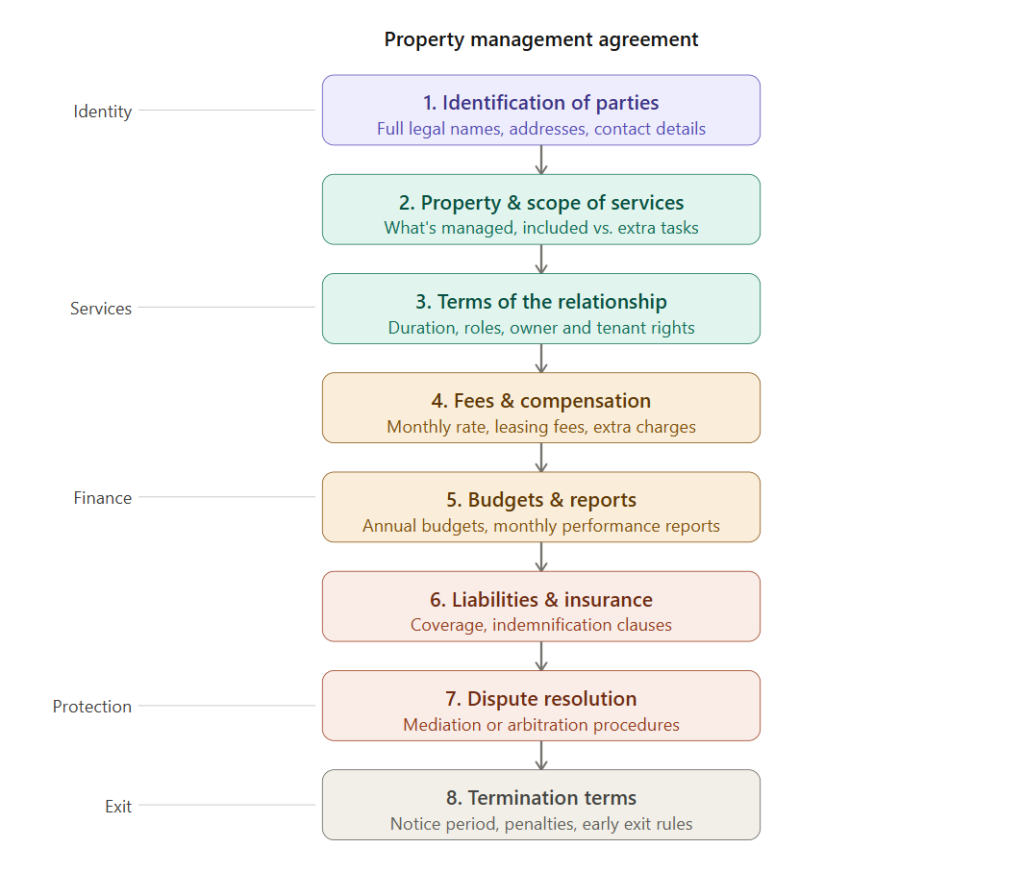
A property management agreement includes key sections that define services, responsibilities, fees, and legal terms. A clear structure helps both the property owner and the management company avoid confusion and stay compliant with laws.
Property Management Contract Checklist
A standard property management contract template should include:
- Identification of parties: Defines who is involved in the agreement and their legal identity
- Property details and scope of services: Explains what property is managed and what services are included
- Terms of the relationship: Defines duration, roles, and responsibilities
- Fees and compensation: Explains how the manager gets paid and what charges apply
- Budgets and reports: Defines how financial tracking and reporting will work
- Liabilities and insurance: Covers risk, damages, and legal protection
- Dispute resolution: Explains how conflicts will be handled
- Termination terms: Defines how and when the contract can end
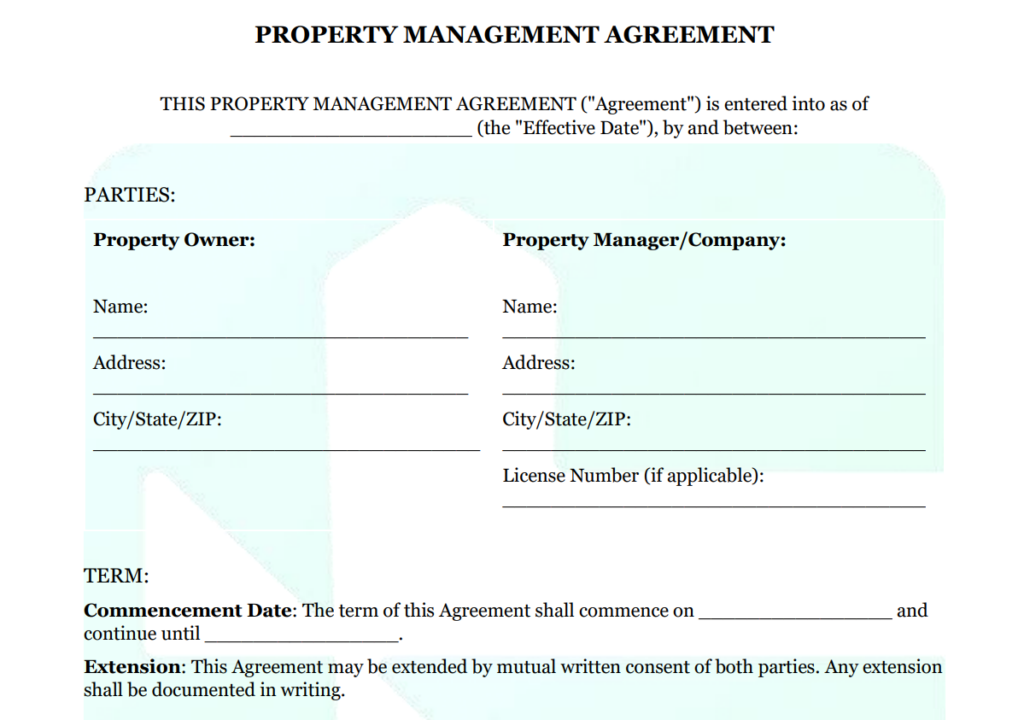
1. Identification of Parties
This section clearly defines who is part of the agreement. It includes the full legal names, addresses, and contact details of both the property owner and the management company.
This is not just basic information. It makes the property management contract agreement legally valid and enforceable. If any issue arises, this section helps identify who is responsible and who can take legal action. You can also include business registration details or license information if required in your state.
Example of Proper Party Identification:
This Property Management Contract (“Contract”) is entered into on 2026 between:
[Full Legal Name of Property Owner], residing at [Address], with contact number [Phone Number], and email address [Email Address], hereinafter referred to as the “Property Owner.”
and
[Full Legal Name of Property Management Company], a [Type of Legal Entity] registered in [State/Country], with registration number [Registration Number], having its principal office at [Address], represented by [Name and Title of Representative], with contact number [Phone Number] and email address [Email Address], hereinafter referred to as the “Property Management Company.”
2. Property Description and Scope of Services
This section defines what property is being managed and what the property manager is expected to do. It is one of the most critical parts of a property management agreement, because most disputes happen when the scope of work is unclear.
The contract should clearly describe the property, including its location, size, and type. It should then define the full scope of services covered under it, such as rent collection, tenant communication, maintenance, inspections, and leasing.
To avoid confusion, this section should clearly explain:
- What services are included in the base agreement
- What services are not included
- What services will require additional fees
A strong property manager agreement should also define how tenant-related tasks will be handled, including communication, inspections, and legal notices.
Under the Fair Housing Act, property managers must treat all tenants equally and cannot discriminate during screening, leasing, or property services. Recent updates also highlight that even automated tools or AI-based tenant screening must follow these rules. If a system leads to unfair treatment, it can still violate federal law.
In simple terms, this section should clearly define what you will do, what you will not do, and how you will stay compliant.
3. Terms of the Relationship
Your clients will be looking for a clear understanding outlined in the contract about how your relationship with them will function. This includes all aspects of the relationship such as:
- How long will the relationship be? One to two years is common.
- Who is responsible for what? You’ll be responsible for services provided, but will you require your client to pay for insurance, parts needed for maintenance, or additional services?
- What rights does the client have? Rights to privacy, withhold payment, etc.
- How will disputes be handled? The more detailed your contract is, the better. Disputes generally arise from uncertainty or things being unclear.
The clearer you are about how the relationship will function, whether it be everyday interactions or emergency situations, the better picture a client can get about how the relationship will go.
Clients also want to see how your relationship with the tenants will function. Include terms of the relationship and be as specific as you can in the property management contract.
4. Fees and Compensation
The financial aspect is a critical element of any property management contract. The agreement should outline the fees and compensation structure for the property management services. This may include a percentage of the monthly rent, flat fees, leasing fees, maintenance charges, and any additional expenses that the property owner might be responsible for.
Your client is looking for specifics about what you’ll charge, why, and in what instances the rate may change. If you’re vague or unclear about certain fees in the property management contract, you can expect your client to ask questions about how much the fees will be, or they may go with another more detailed company and spare themselves the trouble of asking you.
State what your monthly rate is, in what instances that rate would change, and any fees for additional services that are required.
There may be fees for added tasks the client requires of you outside of your normal responsibilities, fees for any changes in the contract or the duration of time, or fees for terminating the contract.
5. Budgets and Reports
The property management contract must include annual operating and capital budgets for each property to plan and track income and expenses. Ideally, budgets should be updated quarterly.
The property manager or property management company must also prepare monthly reports for property owners showing financial performance vs. budget, occupancy %, rents, maintenance issues, capital plans, etc.
Property management software like RentPost™ generates reports on demand for both landlords and owners and help track and report on key performance indicators.
6. Liabilities and Insurance
To safeguard both parties, this contract section should also include liability and insurance matters. The contract should clearly state who is responsible for issues like property damage, tenant disputes, or operational errors. It should also define the insurance coverage required for both parties.
Most property management contracts require the manager to carry:
- general liability insurance to cover injuries, damages, and legal claims
- professional liability insurance to cover mistakes, negligence, or service errors
The agreement should also include indemnification clauses. These clauses explain how one party will protect the other from losses caused by their actions. For example, the owner may protect the manager for actions taken within scope, except in cases of negligence.
Clear liability and insurance terms are important because property management involves daily risks. A well defined section helps both parties understand their exposure, stay compliant, and avoid costly disputes.
7. Dispute Resolution
A dispute resolution clause in the property management contract is essential to provide a framework for resolving conflicts or disagreements that may arise during the contract period. Mediation or arbitration procedures can be outlined, saving both parties time and money by avoiding costly legal battles.
Including a dispute resolution clause in a property management contract is a vital element that promotes effective communication, transparency, and problem-solving between the property owner and the management company. Dispute resolution clauses outline the agreed-upon procedures for resolving conflicts, helping both parties understand how disagreements will be handled.
A clear dispute resolution process helps both parties resolve issues faster, reduce costs, and maintain a strong working relationship.
8. Termination of Relationship
Earlier, many contracts followed a standard 30-day notice rule before termination. However, recent updates from the U.S. Department of Housing and Urban Development (HUD) have changed this approach.
HUD has moved away from a fixed federal notice requirement. Instead, notice periods now depend on the lease terms, housing program, and state or local laws.
In some cases, the notice period can be shorter. For example:
- Around 14 days in public housing
- Based fully on lease and state rules in other programs
Because of this, your property management contract should clearly define:
- How much notice is required
- When early termination is allowed
- Whether any penalties or fees apply
A clear termination clause ensures legal compliance, reduces disputes, and protects both parties from sudden or unfair contract exits.
How RentPost™ helps property managers in managing rental properties
The RentPost™ property management software provides an all-in-one solution to simplify and automate the many complex administrative tasks involved in managing rental properties.
From collecting online rent payments to advertising vacancies and screening tenants to maintenance coordination and accounting, our platform centralizes and optimizes rental property operations to save managers time and money while improving tenant services.
With powerful reporting and predictive insights, property managers using our software gain visibility across portfolios to make more informed decisions.
Collect Rent Payments

- Online tenant portals allow tenants to easily pay rent digitally, avoiding late payments. Automate payment reminders and late fees.
Property Accounting

- The software centralizes accounting by syncing bank accounts, generating financial reports, tracking income and expenses, and supporting tax preparations.
Maintenance Management

- Tenants can request maintenance via the portal. The software tracks maintenance tasks, assigns work orders to contractors, and ensures completion.
Tenant Screening

- Integrated background check services screen tenant applicants, checking credit, income, and criminal history, to reduce rental risks.
Leasing Workflow

- From listing vacancies online to digital lease signing, the software guides managers through the entire lease lifecycle.
Inspection Checklists

- Complete move-in/move-out inspections using pre-defined checklists on a mobile device, documenting conditions with photos.
By centralizing rental property management, managers save time through automation, track detailed financial and operational data, demonstrate compliance, and provide an improved tenant experience.
Check out the RentPost™ software full features list.
Property management agreement template example


Download the free agreement contract template

FAQs related to property management agreement
How long should be a property management contract?
The standard property management contract term ranges from 12 to 24 months. Annual contracts allow property owners to regularly review and provide feedback on the manager’s performance.
Auto-renewal options can be included if both parties are satisfied, while 30-60 days termination notice clauses give flexibility if issues arise.
Lengthier 3- to 5-year contracts may favor larger PM firms but limit owner control. Ultimately the contract term should allow enough time for the manager to add value through tenant retention and operational improvements.
What is the difference between a lease and an agreement contract?
A lease agreement governs the relationship between owner and tenant, while the property management agreement outlines the relationship between the owner and manager of the property.
What are the dangers of not having a proper property agreement contract?
Without a detailed contract, expectations around management responsibilities, fees, and ownership rights may be unclear, leading to confusion and conflict later on.
The lack of outlined financial and reporting procedures increases risks around mishandling funds, non-payment, or misaligned incentives, while the absence of termination provisions, liability clauses, and enforcement measures leaves no options if a manager underperforms or causes financial damage.
With no defined communication protocols, rental issues may escalate without owner awareness, harming tenant relations and property operations.
Essentially, a loose verbal agreement raises liability, weakens the owner’s position, and exposes the asset to preventable operational and financial risks that a strong written contract could mitigate.
Final thoughts
A well-crafted property management contract is the cornerstone of a successful partnership between property owners and management companies. By including key components such as clear identification, scope of services, duration, fees, responsibilities, insurance, and dispute resolution, the contract ensures transparency, accountability, and legal compliance.
When both parties understand their obligations and expectations from the beginning, the property management process is more likely to be efficient, harmonious, and beneficial for all involved.
Authors