Log in
 Free Trial
 jacob-thomason
  48 views
  1
1
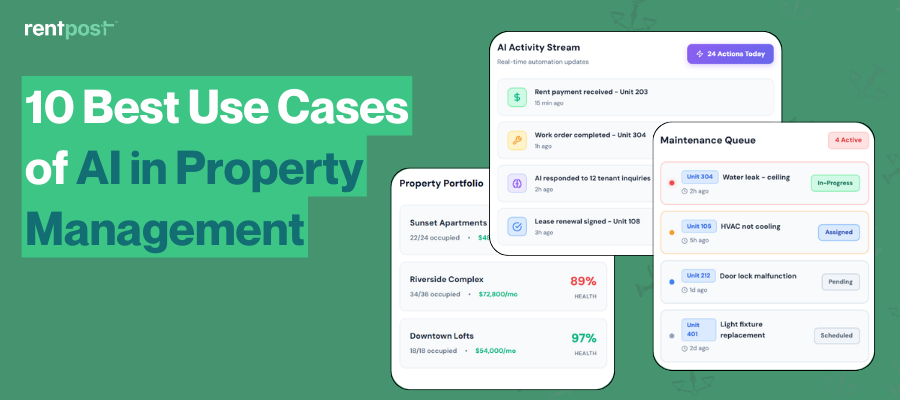
Property management is getting more complex, not easier. AI helps by removing repetitive work like follow ups scheduling and data checks.
When used the right way, it improves response speed reduces risks and supports better decisions.
This guide breaks down 10 practical ways to use AI in property management along with clear benefits and real limitations.
How to Use AI in Property Management? 10 AI use cases in property management
AI in property management isn’t about replacing people. It’s about removing the repetitive work that slows everything down. Tasks like follow-ups, scheduling, and data checks can now run in the background.
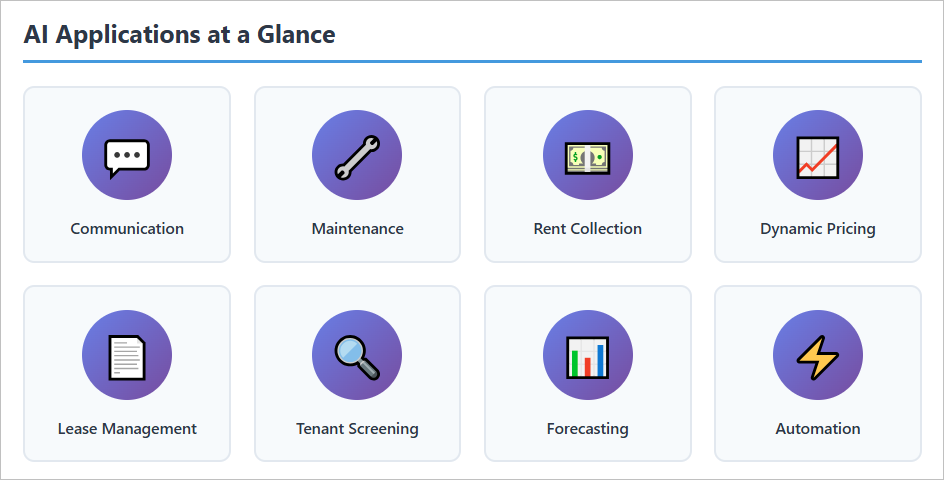
When used well, AI helps property managers respond faster, spot risks earlier, and make smarter decisions without adding more staff or stress.
👉 Get a free demo of Property Management Software by RentPost
1. AI-Powered Tenant Communication That Actually Reduces Work
Modern AI communication tools do more than answer FAQs. They connect directly to lease data, payment systems, and maintenance logs. For example, when a tenant asks, “Why is my balance showing late fees?”, the AI can check payment history, explain the charge, and even guide the tenant to pay immediately. Some systems also detect sentiment, flagging frustrated tenants for human follow-up. This reduces back-and-forth emails, shortens response times, and prevents small issues from escalating.
Property managers benefit because communication stays consistent, documented, and scalable without hiring additional support staff.
2. Intelligent Maintenance Ticket Prioritization
AI can read maintenance requests and understand urgency based on keywords, historical data, and asset type.
For instance, “water leaking from ceiling” is instantly flagged as critical, while “loose door handle” is scheduled as low priority. Over time, AI learns which issues lead to costly repairs if delayed. This helps managers act before problems worsen. In large portfolios, this prevents maintenance teams from being overwhelmed and ensures resources are allocated where they matter most.
The result? Faster response for serious issues and better control over repair costs.
3. Predictive Maintenance for High-Cost Equipment
AI-driven predictive maintenance uses data from smart meters, HVAC systems, and historical repair logs. For example, rising energy usage in one unit may signal an aging AC compressor. AI alerts managers weeks before failure, allowing planned maintenance instead of emergency repairs. This reduces downtime, avoids tenant complaints, and extends equipment lifespan.
Large operators already use this to reduce maintenance spend by double digits. Instead of reacting to breakdowns, property managers gain foresight, which is especially valuable in multifamily and commercial portfolios.
4. AI-Based Rent Collection and Delinquency Prevention
AI systems analyze payment behavior to predict late payments before they happen. If a tenant historically pays late after holidays or job changes, the system triggers early reminders or payment plan suggestions. For example, tenants may receive a nudge five days earlier than usual, increasing on-time payments without confrontation. If applied carefully, this lowers arrears and stabilizes cash flow.
Managers also get dashboards showing risk levels across the portfolio, helping them intervene early rather than chasing overdue rent after the fact.
5. Dynamic Rent Pricing Using Market Intelligence
AI pricing tools track local listings, demand trends, seasonality, and vacancy rates in real time. So, instead of setting rents once a year, managers receive data-backed pricing recommendations weekly or monthly. For example, if comparable units nearby lease faster at slightly lower rates, AI suggests a small adjustment to reduce vacancy days. Conversely, high demand periods trigger upward pricing opportunities.
This balances occupancy and revenue better than static pricing strategies and helps owners capture market value without overpricing units.
6. Lease Abstraction and Compliance Monitoring
AI can scan lease documents and extract key details such as rent escalations, renewal clauses, penalties, and compliance obligations. This is especially useful when managing hundreds of leases with different terms. For example, AI alerts managers when renewal windows open or when rent increases are contractually allowed. This reduces missed opportunities and legal risk. It also enables faster reporting for owners.
Instead of digging through PDFs, managers access structured, searchable lease data instantly.
7. Smarter Tenant Screening with Risk Detection
AI enhances tenant screening by analyzing patterns humans often miss. Beyond credit scores, it looks at income stability, past rental behavior, and inconsistencies across documents. For example, mismatched employment timelines or repeated short stays can indicate higher turnover risk. AI doesn’t replace judgment, but it highlights risk factors early. This leads to better tenant quality, fewer evictions, and lower turnover.
As adoption increases, managers build a more stable tenant base without slowing down the leasing process.
8. Vacancy and Turnover Prediction
AI analyzes lease length, maintenance frequency, complaint history, and rent changes to predict which tenants are likely to move out. For example, a tenant requesting multiple repairs and nearing lease end may be flagged as high-risk. Managers can proactively engage, offer renewals, or prepare marketing early. This reduces vacancy periods and helps plan inspections and cleaning ahead of time.
Predictive vacancy management turns leasing into a proactive process instead of a reactive scramble.
9. Financial Forecasting and Portfolio Insights
AI-powered financial tools forecast cash flow, maintenance budgets, and operating costs using historical and real-time data. For example, they can project next quarter’s expenses based on aging equipment or seasonal repair trends. This supports better budgeting and owner reporting. Instead of static spreadsheets, managers get scenario-based forecasts that adapt as conditions change.
This improves decision-making and builds credibility with property owners who want transparency and predictability.
10. End-to-End Workflow Automation with AI Agents
Advanced AI agents can connect systems across leasing, maintenance, accounting, and communication. For example, a maintenance request automatically triggers vendor assignment, tenant updates, cost tracking, and invoice approval. Managers don’t manually move tasks between systems. This reduces errors, speeds execution, and allows smaller teams to manage larger portfolios.
In the long run, automation improves consistency and frees managers to focus on growth, client relationships, and strategic decisions rather than operational firefighting.
Overall, AI works in property management when it solves real operational friction. The most successful managers use it quietly, strategically, and selectively. When applied well, AI doesn’t replace expertise, it amplifies it.
Benefits of Using AI in Property Management
Artificial intelligence is reshaping property management from a task-driven job into a data-informed, proactive discipline. When used thoughtfully, AI helps managers save time, reduce costs, improve tenant experiences, and make better decisions, all while increasing operational resilience.
Traditional vs AI-Enhanced Property Management
| Aspect | Traditional Approach | AI-Enhanced Approach |
| Tenant Communication | Business hours only, delayed responses | 24/7 availability, instant accurate answers |
| Maintenance | Reactive – fix after breakdown | Predictive – prevent failures proactively |
| Rent Pricing | Annual adjustments, manual research | Dynamic, real-time market intelligence |
| Tenant Screening | Manual review, time-consuming | Pattern analysis, faster risk detection |
| Financial Planning | Static spreadsheets, historical data | Predictive forecasting, scenario modeling |
| Vacancy Management | Reactive scramble after notice | Predictive alerts, proactive planning |
These benefits are not abstract tech buzzwords; they’re measurable outcomes already being realized by forward-thinking property teams.
1. Massive Time Savings Through Automation
One of the clearest benefits of AI is its ability to automate routine, repetitive tasks that historically consumed property managers’ time. Tools powered by Natural Language Processing (NLP) and workflow automation handle common tenant communications, rent reminders, lease renewals, accounting entries, and basic reporting. This frees up staff to focus on higher-value work like tenant relationships and strategic planning. According to industry analysis, AI can automate up to 90% of routine tenant workflows and inquiries, dramatically cutting manual effort and reducing human error.
Because these tasks are automated, managers no longer have to juggle calendars, send repetitive messages, or manually sort requests. Instead, AI systems can process high volumes of tenant interaction 24/7, speeding response times and reducing burnout.
2. Predictive Maintenance Reduces Costs and Disruptions
Maintenance is often one of the largest cost centers in property management, sometimes consuming 10-15% of gross rental income annually in reactive repairs. Traditional maintenance is reactive: fix it after it breaks. AI changes the equation by using historical data and sensor inputs to forecast when equipment or systems are likely to fail.
For example, predictive maintenance models can warn managers that an HVAC unit is trending toward failure based on usage patterns, vibration data, or energy consumption. This lets you schedule repairs before tenants complain and before a breakdown becomes a costly emergency. As a result, unpredictable downtime drops, tenant satisfaction increases, and overall maintenance costs shrink, often significantly.
AI’s proactive approach is particularly valuable in larger portfolios where manual monitoring of every system simply isn’t possible. With predictive insights, maintenance planning becomes both efficient and strategic.
3. Enhanced Tenant Experience and Retention
Tenant satisfaction is one of the most impactful, yet hardest to measure, drivers of long-term performance. AI helps here in two major ways: faster communication and personalized service.
AI chatbots and virtual assistants can respond to tenant questions around the clock, significantly improving response times. They answer common queries about leases, amenities, payments, and maintenance without requiring staff intervention. This level of responsiveness contributes directly to tenant satisfaction.
Moreover, AI can personalize communications by analyzing tenant behavior and preferences. For example, AI might learn a tenant prefers text notifications over emails, or that certain maintenance issues recur in specific units. These insights allow managers to tailor interactions and interventions, which increases trust and lowers turnover. Research shows automation and personalization work together to build tenant loyalty and reduce churn.
4. Data-Driven Pricing and Demand Optimization
Setting the right rent price is both art and science. Static pricing, where rent is adjusted only periodically, can leave money on the table or extend vacancy periods unnecessarily. AI changes that by analyzing real-time market data, local occupancy trends, seasonality, and competitive pricing.
With this data, AI tools can recommend rent adjustments that balance occupancy and revenue optimization. In fast-moving markets, these dynamic pricing models help managers react quickly to demand shifts, strengthening both occupancy rates and total rental revenue.
Such insights also inform broader portfolio strategy. By understanding where rents are moving and which units underperform, managers can allocate marketing resources or plan renovations to improve competitiveness.
5. Smarter Tenant Screening and Risk Mitigation
Choosing the right tenant is central to minimizing turnover and rental defaults; however, traditional tenant screening involving manual reviewing applications and credit reports is slow and prone to inconsistency. Isn’t it?
AI enhances this process by rapidly analyzing applicant data and identifying risk indicators such as inconsistent employment histories, past evictions, or payment flags. This supports better decisions when selecting tenants and reduces exposure to defaults or problematic leases.
Additionally, AI helps decrease unconscious human bias in screening by focusing on objective data. When used responsibly, this leads to fairer and more consistent screening outcomes, both reducing legal risk and improving portfolio health.
6. Faster, More Accurate Financial and Operational Decisions
AI doesn’t just automate tasks, it surfaces insights. By analyzing large datasets involving rent collections, maintenance costs, occupancy trends, and tenant behavior, AI systems provide managers with accurate financial forecasts, trend analysis, and resource allocation suggestions. This level of visibility wasn’t possible with manual records and spreadsheets.
For example, AI can forecast upcoming cash flow needs based on lease schedules and predicted vacancies. It helps managers plan budgets more accurately and anticipate shortfalls before they occur. Managers also get actionable dashboards summarizing portfolio performance and anomaly detection alerts when trends deviate from expectations.
These insights equip property owners and managers to make decisions based on patterns and projections, not gut feel.
7. Energy Management and Sustainability Gains
Sustainability goals increasingly influence resident satisfaction, regulatory compliance, and operating costs. AI excels at optimizing energy use by analyzing occupancy patterns, weather forecasts, equipment performance, and historical consumption. Smart building systems driven by AI can, for example, pre-cool buildings ahead of heat waves or adjust lighting and HVAC settings based on real-time usage.
This leads to lower utility expenses and a reduced environmental footprint, which is attractive to residents and owners alike. Optimizing energy use also contributes to long-term asset value preservation and positions properties as forward-thinking and efficient.
8. Competitive Advantage and Market Positioning
Finally, adopting AI gives property managers a strategic edge. Early adopters are already using these tools not just to cut costs, but to differentiate their service offering. Faster responses, predictive maintenance, tailored leasing experiences, and data-driven pricing all become selling points when attracting tenants or pitching owners.
In a competitive market, the ability to run properties more proactively and insightfully translates into stronger reputation, higher occupancy, and improved owner satisfaction.
AI in property management isn’t an optional tech add-on. It is becoming a core business capability that transforms how portfolios are managed, from reactive to proactive, from manual to predictive, and from subjective to data-informed.
What Are the AI Limitations in Property Management?
AI brings real advantages, but it’s not a magic fix. Understanding where it falls short helps property managers use it wisely instead of blindly.
1. Data Quality is the First Challenge
AI systems are only as good as the data they learn from. If rent records are inconsistent, maintenance logs are incomplete, or tenant data is outdated, AI insights can be misleading. Poor inputs lead to poor recommendations, especially in pricing, screening, and forecasting.
2. Bias and Fairness Remain Real Risks
AI used in tenant screening or risk scoring can unintentionally reflect historical bias in the data it was trained on. This creates legal and ethical concerns, particularly around fair housing laws. Without strong oversight, automation can amplify problems instead of solving them.
3. Legal and Compliance Boundaries are Complex
Property management operates under strict regulations that vary by state and city. AI tools may suggest actions that don’t fully align with local landlord-tenant laws, notice requirements, or privacy rules. Blindly following AI outputs without human review can expose managers to compliance risks.
4. Tenant Trust is Fragile
Tenants often feel uncomfortable when decisions appear “machine-driven.” Automated responses, rent adjustments, or screening decisions without clear explanation can reduce trust and increase disputes. Transparency and human touch still matter.
This is where practical platforms like RentPost come in. Instead of replacing judgment, RentPost supports it. It combines automation with clear workflows, human review points, and transparent reporting. Data stays centralized and clean, compliance steps are built into processes, and managers remain in control of final decisions.
💡 Further resources:
- 6 Property Management Software for Short-Term Rentals
- Top 10 Lease Management Software to Manage Tenants
Final Words
AI is quickly becoming a practical advantage in property management, but it works best when used with clear intent and human judgment. Automation can save time, reduce errors, and surface insights that were hard to see before, however it cannot replace context, trust, or accountability.
The real value comes from combining AI efficiency with platforms like RentPost that keep data clean, workflows compliant, and communication transparent.
Used thoughtfully, AI doesn’t take control away from property managers, it gives them more room to focus on decisions that truly move the business forward.
Author