Log in
 Free Trial
 karina
  Updated on March 30, 2026
  16444 views
  8
8

California is one of the most expensive places to live in the US. Rent keeps rising, and tenants worry about sudden increases. At the same time, landlords must follow strict rules to stay compliant.
This guide is updated for 2026 with the latest rent laws and new regulations. It covers rent increase limits under the Tenant Protection Act (AB 1482), along with new 2026 updates like appliance requirements, electronic security deposit returns, tenant data protection, and fee transparency rules.
If you are a landlord or tenant, this article will help you understand what changed, what stayed the same, and what you need to do now to stay compliant.
💡 NOTE FOR PROPERTY MANAGERS & LANDLORDS:
Simplify your rent collection and property management with our risk-free 30-day trial. No credit card required – start managing your properties smarter today.
Key takeaways: Rent increament in California
- California limits rent increases under AB 1482 to 5% plus CPI or 10%, whichever is lower.
- Landlords must follow the same rent cap rules for both yearly and month-to-month leases.
- Not all properties are covered. Some homes, like certain single-family units and newer buildings, are exempt.
- New 2026 laws add rules for appliances, deposit returns, data security, and fee transparency.
- Landlords must give proper notice within the required timeframe before increasing rent.
- State and local rent control laws work together to protect tenants and regulate rent increases.
What is the rent increase limit in California for 2026?
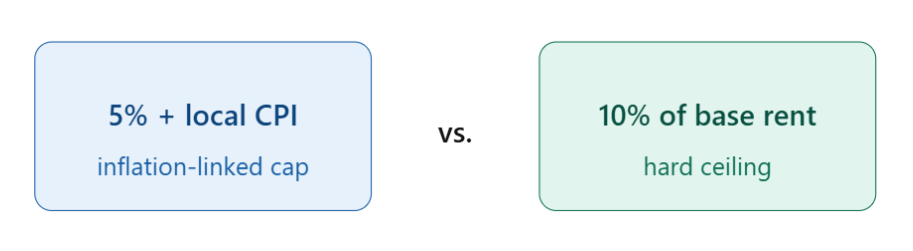
The Tenant Protection Act (AB 1482) now caps annual rent increases for many residential properties at 5% plus the regional inflation rate (CPI), or 10%, whichever is lower. This law sets a clear statewide limit and helps prevent sudden or excessive rent hikes. The California Consumer Price Index (CA CPI), published by the state’s Department of Finance, is used to calculate the allowed increase each year.
Before this law came into effect in 2019, California did not have a statewide rent cap. Cities and counties created their own rent control rules. Only around 20 cities and counties in California had any form of rent control, while most areas had no limits at all.
In those areas without rent control, landlords could raise rent by any amount when renewing a lease or issuing a rent increase notice, as long as they followed the terms in the rental agreement. This often led to large and unpredictable rent increases for tenants.
How much can rent increase per year in California?
Residential properties covered under the Tenant Protection Act (AB 1482) can increase rent each year based on a fixed limit. Landlords must choose the lower of these two options:
- 5% plus the regional inflation rate (CPI)
- 10% of the lowest rent charged in the past 12 months
This rule ensures that rent increases stay controlled, even when inflation is high.
For example, if a unit rents for $1,500 and the CPI is 2.3%, the allowed increase is 7.3%. The new rent becomes $1,609.50. If the CPI rises to 5.8%, the total increase would reach 10.8%, but the law caps it at 10%. In this case, the new rent becomes $1,650.
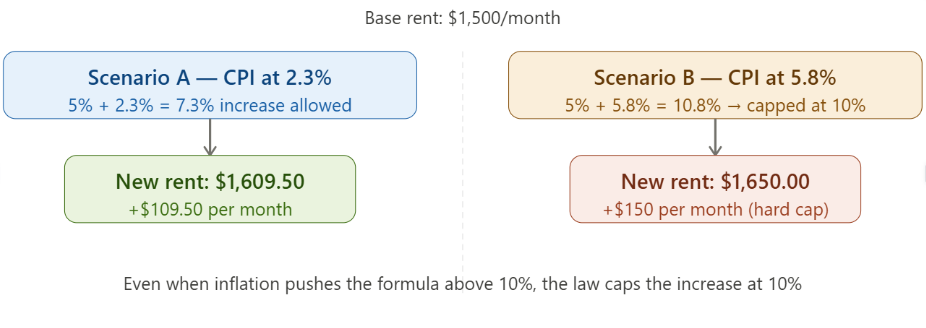
This yearly limit applies to the total increase within a 12-month period, even if the landlord raises rent in multiple steps.
Can landlords increase rent for month-to-month leases in California?
Yes. Landlords can increase rent for month-to-month leases, but they must follow the same limits under the Tenant Protection Act (AB 1482).
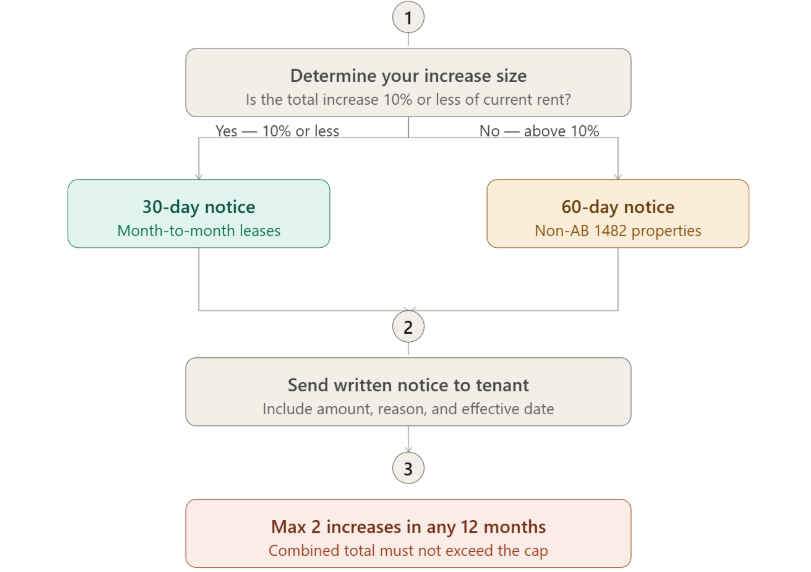
The increase must stay within the legal cap, based on the lower of 5% plus the CPI or 10% of the lowest rent charged in the past 12 months. This rule applies to the total increase within 12 months, even if the landlord makes changes more than once.
A written notice specifying the amount, reason, and effective date of the increase must be sent to tenants within this timeframe. The notice timeframe depends on the size of the increase. For increases of 10% or less, landlords must give at least a 30-day notice. For increases above 10%, a 60-day notice applies, mainly for properties not covered under AB 1482 or local rent control laws.
What properties are covered by the California Tenant Protection Act (AB 1482)?
The Tenant Protection Act (AB 1482) applies to most residential rental units in California. However, some property types are exempt from this law. These include:
- Single-family homes not owned or controlled by a corporation or REIT (if owned by such entities, the law may apply)
- Units covered by a local rent control law that is more protective
- Properties with a certificate of occupancy issued within the last 15 years (rolling basis)
- Mobile homes, unless owned and rented by the park owner or manager
- Duplexes where the owner lives in one unit
- Affordable housing units with government restrictions or subsidy agreements
- Dormitories
The law took effect on January 1, 2020, to address the housing crisis. It is set to remain active until January 1, 2030, unless extended.
What is the rent cap in California?
In California, the Tenant Protection Act (AB 1482) sets a statewide rent cap that limits how much landlords can increase rent each year for covered properties. This cap applies to most residential units and helps control sudden rent increases.
The allowed increase must stay within the lower of these two amounts: 5% of the current rent plus the local inflation rate (CPI), or 10% of the current rent. This ensures rent increases remain predictable and within a fixed limit.
California Rent Increase Laws for 2026
Tenant Protection Act (AB 1482) of 2019
The Tenant Protection Act of 2019 is the most significant and far-reaching rent control legislation in California. This statewide law serves as the primary determinant of rent control policies across the state, imposing limits on annual rent increases for most residential properties.
While some cities and counties have their own local rent control ordinances, the Tenant Protection Act establishes a baseline standard that applies even in areas without specific local measures.
In addition to the Tenant Protection Act (AB 1482), residential landlords and tenants should be fully aware of other existing laws and provisions governing rent increases in the state of California as of 2025.
Costa-Hawkins Rental Housing Act
The Costa-Hawkins Rental Housing Act passed in 1995, placed significant limitations on local rent control laws in California. It prohibited cities from applying rent control to single-family homes, condominiums, and any housing units first occupied after February 1, 1995.
Costa-Hawkins still limits the scope of AB 1482 in a few key ways:
- Rent control exemption for newer units: AB 1482 cannot regulate rents for units first occupied within the last 15 years, as per Costa-Hawkins.
- Vacancy decontrol: Landlords can still raise rents to market rates when a unit becomes vacant, as allowed by Costa-Hawkins.
- Preemption of stricter local laws: In areas with local rent control, the less restrictive of the two laws (AB 1482 or the local law) applies.
While AB 1482 provides statewide rent caps and protections, it operates within the boundaries set by Costa-Hawkins, which continues to constrain the application of rent control in certain cases and prevents the state from implementing stronger rent control measures.
Consumer Price Index (CPI) Reference for Rent Increase
The Tenant Protection Act (AB 1482) must use the Consumer Price Index (CPI) from April of each year to determine the allowable rent increase limit. However, the applicable CPI percentage depends on when the rent increase takes effect:
- For rent increases effective before August 1st: Use the April CPI percentage from the previous year rounded to the nearest one-tenth of a percent.
- For rent increases effective on or after August 1st: Use the April CPI percentage from the current year, rounded to the nearest one-tenth of a percent.
Landlords need to apply the correct April CPI value based on whether the rent hike happens before, on, or after August 1st of any given year.
How often can a landlord raise rent in California?
Landlords can only raise rent twice each year in California. The Tenant Protection Act of 2019 (AB 1482) explicitly states:
“The bill would prohibit an owner of a unit of residential real property from increasing the gross rental rate for the unit in more than 2 increments over a 12-month period, after the tenant remains in occupancy of the unit over a 12-month period.”
Moreover, the sum of two increases must not exceed the allowable margin of either 5% of the current rent plus the local inflation rate or 10% of the current rent.
Single-family home rent increase in California
Single-family homes in California are exempt from rent control laws like the Costa-Hawkins Rental Housing Act and the Tenant Protection Act of 2019 (AB 1482). There are no statewide limits on how much landlords can increase rent each year for single-family homes.
Without being covered by rent control, landlords of single-family homes can raise the rent by any amount when leases expire or renew. The rent increases are not legally capped or regulated at the state level, except for those owned or controlled by a corporation or REITs, which are subject to the provisions of AB 1482.
Some cities in California may have their own local ordinances that apply rent increase caps even to single-family homes. However, state rent control laws allow unlimited annual rent hikes for single-family residences not subject to local rent control rules.
Does California have rent control?
Yes, California has rent control at both the state and local levels. The main statewide law is the Tenant Protection Act (AB 1482), which limits how much landlords can increase rent each year for many residential properties.
Under this law, rent increases are capped based on a fixed rate, which helps prevent sudden and large hikes. In addition to the state law, some cities and counties have their own rent control rules. These local laws may offer stricter limits and additional protections for tenants.
Together, state and local regulations create a system that controls rent increases, sets clear limits, and provides more stability for tenants across California.
Can a landlord raise rent by more than 10% in California?
No, the California Tenant Protection Act of 2019 explicitly states that landlords can raise rent annually by 5% plus the local inflation rate (CPI), or 10%, whichever is lower. The maximum allowable increase is thus 10%, nothing more.
Let’s look back to when inflation was at its highest in 2022 up to early 2023. During this period, high inflation rates drove up regional Consumer Price Index (CPI) figures, so the entire state of California hit the 10% rent increase cap under AB 1482.

Rather than being limited to 5% plus the local CPI rate, landlords were allowed to raise rents up to 10% annually since 10% was the lower of the two allowable rent increase calculations dictated by the law.
What are the new rental laws in California for 2026?
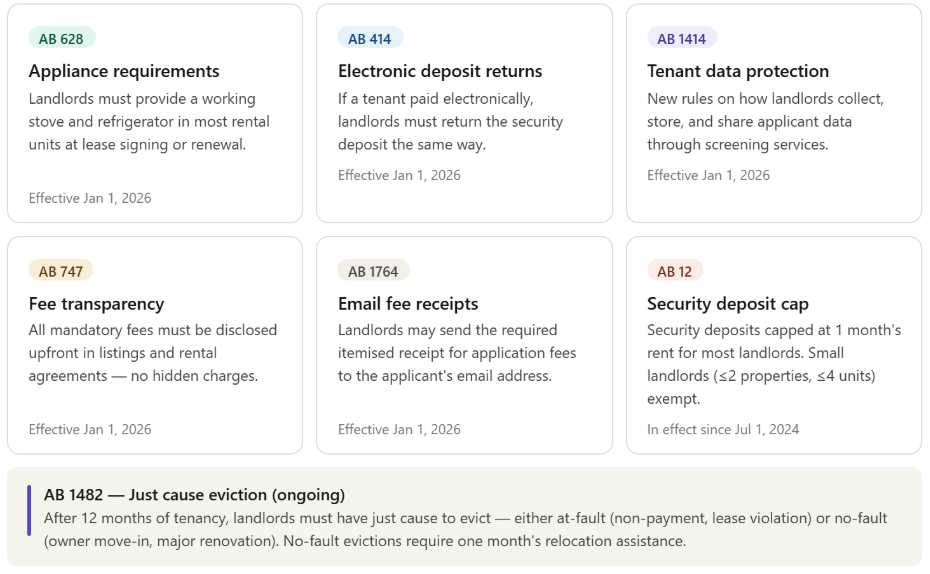
California introduced several new rental laws in 2026. These updates focus on habitability, deposit handling, tenant rights, and pricing transparency. Landlords must review their leases and processes to stay compliant.
Assembly Bill 628 – Appliance requirements
California has expanded habitability standards for rental properties. Assembly Bill 628 requires landlords to provide a working stove and refrigerator in most rental units.
Effective January 1, 2026, this rule applies when a landlord enters into a new lease, renews an existing lease, or makes changes to lease terms. Once these appliances are provided, landlords must handle repair or replacement due to normal use.
While adding these requirements, the law aims to improve basic living conditions and ensure tenants have access to essential kitchen facilities.
Assembly Bill 414 – Electronic deposit returns
California has updated the process for returning security deposits. Assembly Bill 414 requires landlords to return deposits electronically if the tenant used electronic payment methods during the tenancy.
This change applies at the time of move-out. Landlords must also inform tenants about their right to receive the deposit electronically.
The law does not change the 21-day deadline, allowed deductions, or the requirement to provide an itemized statement. It aims to make the refund process faster and more convenient.
Assembly Bill 1414 – Tenant data and screening rules
California has introduced new rules to improve how landlords handle tenant data and screening processes. Assembly Bill 1414 focuses on protecting applicant information and ensuring proper use of third-party screening services.
Landlords must review how they collect, store, and manage tenant data. They must also ensure that any screening vendors follow proper security practices. With this amendment, the law aims to reduce risks related to data misuse and improve transparency in tenant screening decisions.
Assembly Bill 747 – Fee transparency rules
California has strengthened rules around fee transparency in rental housing. Assembly Bill 747 requires landlords to clearly disclose all mandatory fees associated with renting a unit.
This applies when landlords advertise properties, share rent details, or charge recurring fees. All required costs must be shown upfront, not added later in the leasing process.
The law aims to prevent hidden charges and help tenants understand the full cost of renting before making a decision.
Assembly Bill No. 12 – Security Deposits Limit
California has taken a significant step to make housing more accessible by limiting security deposits for renters. Assembly Bill No. 12, signed into law by California Governor Gavin Newsom, aims to enhance housing affordability and accessibility for renters.
Effective July 1, 2024, the bill caps security deposits at an amount equivalent to one month’s rent, addressing the widespread practice of landlords demanding excessive deposits, sometimes up to three months’ worth.
This legislation makes California the twelfth state to implement such a limit on security deposits. However, it exempts small landlords with no more than two properties and four units in total from the cap.
Regulating security deposit amounts, the bill seeks to ease the financial burden on renters and promote greater housing opportunities across the state.
Assembly Bill 1482 – Just Cause Eviction Categories
Under California’s AB 1482 rent control law, landlords must demonstrate ‘just cause’ to evict tenants after they have lived in a unit for at least 12 months, or if one tenant has resided there for 24+ months. This prevents evictions solely to raise rent on new tenants beyond the cap.
The law outlines two ‘just cause’ categories:
- ‘at-fault’ for violations like nonpayment of rent or criminal activity, requiring a chance to cure
- ‘no-fault’ reasons like owner move-in or renovations, requiring one month’s relocation assistance
These provisions protect long-term tenants from arbitrary evictions while allowing landlords to reclaim properties under legitimate circumstances specified in the legislation.
Assembly Bill No. 1764 – Applicant Fee Receipt Requirements
Current California law mandates that when an applicant pays a fee to rent a residential property, the landlord or their agent must provide an itemized receipt detailing the out-of-pocket costs and time spent processing the applicant’s information.
Assembly Bill 1764 (2) proposes an amendment that would allow the landlord or their agent to send this required receipt for the applicant’s paid fee to an email address provided by the applicant, rather than necessarily providing a physical printed copy if both parties agree to this electronic delivery method.
How to manage your rental property and rent collection
Collecting rent from tenants can present various challenges for landlords. One of the most common issues is late or missed payments, which can disrupt the landlord’s cash flow and create financial strain.
Collecting rental payments manually is also an arduous and time-consuming process fraught with potential issues. Landlords must keep meticulous records of payments received and alert tenants of missed or late rent.
Processing cash or checks is also inconvenient, as trips to the bank to deposit funds waste valuable time. Manual payment tracking often results in errors in bookkeeping.
Overall, the lack of automation bogs down operations, hindering cash flow and consuming unnecessary administrative resources better allocated elsewhere.
Automating rent collection through RentPost property management software
Property management software like RentPost is crucial for landlords and property managers to automate the time-consuming task of rent collection.

Here’s how RentPost streamlines rent collection in a breeze.
- RentPost sends out automatic reminders to tenants when rent is due.
- Tenants can pay securely via ACH bank transfers or credit cards with a few clicks. Tenants may use any US-based bank account or Credit Card (Visa, Mastercard, or American Express).
- Tenants can also opt for the AutoPay rent payment method. RentPost gives tenants AutoPay convenience so they never have to worry about missing rent payments.
- On the backend, RentPost integrates with Payshift to track rent payments, assess late fees when applicable, and maintain detailed records. Landlords get real-time updates on outstanding balances across all their properties.
Overall, RentPost reduces errors, missed payments, and the hassle of manually collecting and depositing checks from each tenant. It’s our way of simplifying rent collection for both landlord and tenant.
Elevate property management and witness the transformative impact firsthand.
Sign up for our risk-free 30-day trial, no strings attached.
No credit card required, no obligations – just pure convenience at your fingertips!
Author