Log in
 Free Trial
 karina
  Updated on September 3, 2026
  210 views
  0
0
You just found out someone is living in your vacant New York rental. They are not on the lease. You never gave them a key. And now you are wondering if you can lose your property to them.
That fear is common, and it is also mostly overblown. Squatters rights in New York do exist, but the bar to actually gain ownership through adverse possession is high, and a 2024 law change made it easier to remove a squatter without a drawn-out court battle.
Before taking action, it helps to understand how squatter rights work in New York and how they differ from the rights of a legal tenant. This guide breaks down what New York law says about squatters, when they may gain certain legal protections, and the steps you need to take to remove a squatter legally.
What Is a Squatter Under New York Law
A squatter is a person who enters or occupies a property without the permission of the owner, and who has no lease, title, or legal right to be there.
New York law spells this out directly. Under Real Property Actions and Proceedings Law (RPAPL) Section 711, a squatter is defined as someone who enters or intrudes upon real property without the permission of the person entitled to possession, and continues to occupy the property without title, right, or permission of the owner or the owner’s agent.
That definition matters because RPAPL 711 also states plainly that a tenant shall not include a squatter. This single sentence, added to the law in 2024, is the reason New York squatter removals now move faster than they used to.
Before diving into the legal details, here is a quick overview of the most important things every New York landlord should know about squatters rights:
| Topic | New York Rule |
| Adverse possession period | 10 continuous years |
| Notice required to remove a squatter | 10 Day Notice to Quit (RPAPL § 713) |
| Can a squatter become a tenant after 30 days? | No. The 2024 law says squatters are not tenants simply because they stayed 30 days. |
| Can landlords change the locks? | No. Self help evictions are illegal. |
| Who can physically remove a squatter? | A sheriff, marshal, or other authorized law enforcement officer with a court order. |
| Can police remove a squatter immediately? | Sometimes, but only before the person establishes occupancy. |
| Can a squatter claim ownership? | Only if they meet all adverse possession requirements for 10 continuous years. |
Also Read: Complete Guide to Massachusetts Squatters’ Rights
Squatter vs. Tenant vs. Trespasser: Know the Difference
Before taking any action, it is important to understand whether the person is a tenant, a trespasser, or a squatter. The legal process is different for each one:
- Tenant: A tenant has permission to live on the property. They signed a lease, paid rent, or moved in with your approval. Because they have a legal right to occupy the property, you must follow the formal eviction process if you want them to leave.
- Trespasser: Unlike a tenant, a trespasser enters the property without permission and has not established residency. If someone is caught breaking into the property or entering unlawfully, you can usually contact the police to have them removed.
- Squatter: A squatter is different from both a tenant and a trespasser. They entered the property without permission but have started living there. For example, they may have moved in furniture, started receiving mail, or set up utility services. Once they establish occupancy, New York law requires you to follow a legal process to remove them, even though they never had your permission to stay.
The situation can become more complicated because some squatters try to present themselves as tenants. They may show a fake lease or claim that a previous owner gave them permission to live there. In these cases, you should be prepared to prove that they never had legal permission to occupy the property in the first place.
The 2024 New York Law Change Every Landlord Should Know
For many years, many landlords believed that if someone stayed in a property for 30 days, they automatically became a tenant. This created a lot of confusion because people thought squatters had the same legal rights as tenants.
In April 2024, New York updated the law to make this much clearer. The new law says that a squatter is not a tenant if they never had permission to live in the property.
In other words, staying in a property for 30 days does not automatically give someone tenant rights. If they moved in without your permission, they are still considered a squatter under the law.
However, this does not mean you can remove a squatter on your own. You still have to follow the legal process. The good news is that removing a squatter is usually faster and simpler than evicting a legal tenant because the law does not treat squatters as tenants.
Common Myths About Squatters Rights in New York
The recent law change has cleared up several common misconceptions. Here are some of the biggest myths landlords still hear and the facts behind them:
| Myth | Reality |
| A squatter automatically becomes a tenant after 30 days. | False. The 2024 law makes it clear that squatters are not tenants simply because they stayed for 30 days. |
| Landlords can change the locks to remove a squatter. | False. Self help evictions are illegal in New York. |
| Police will always remove a squatter immediately. | False. Once someone establishes occupancy, the case is usually handled through the courts. |
| Paying property taxes automatically gives a squatter ownership. | False. Paying taxes alone does not create ownership rights. |
| Any squatter can claim ownership of a property. | False. A successful adverse possession claim requires meeting strict legal requirements for 10 continuous years. |
| Adverse possession is common in New York. | False. Most claims fail because one or more legal requirements are not met. |
How to Legally Remove a Squatter in New York
Even with the 2024 law change, you cannot simply change the locks or physically remove a squatter yourself. Self-help evictions, including changing locks or shutting off utilities, are illegal in New York under RPAPL Section 768 and can expose you to civil and criminal penalties.
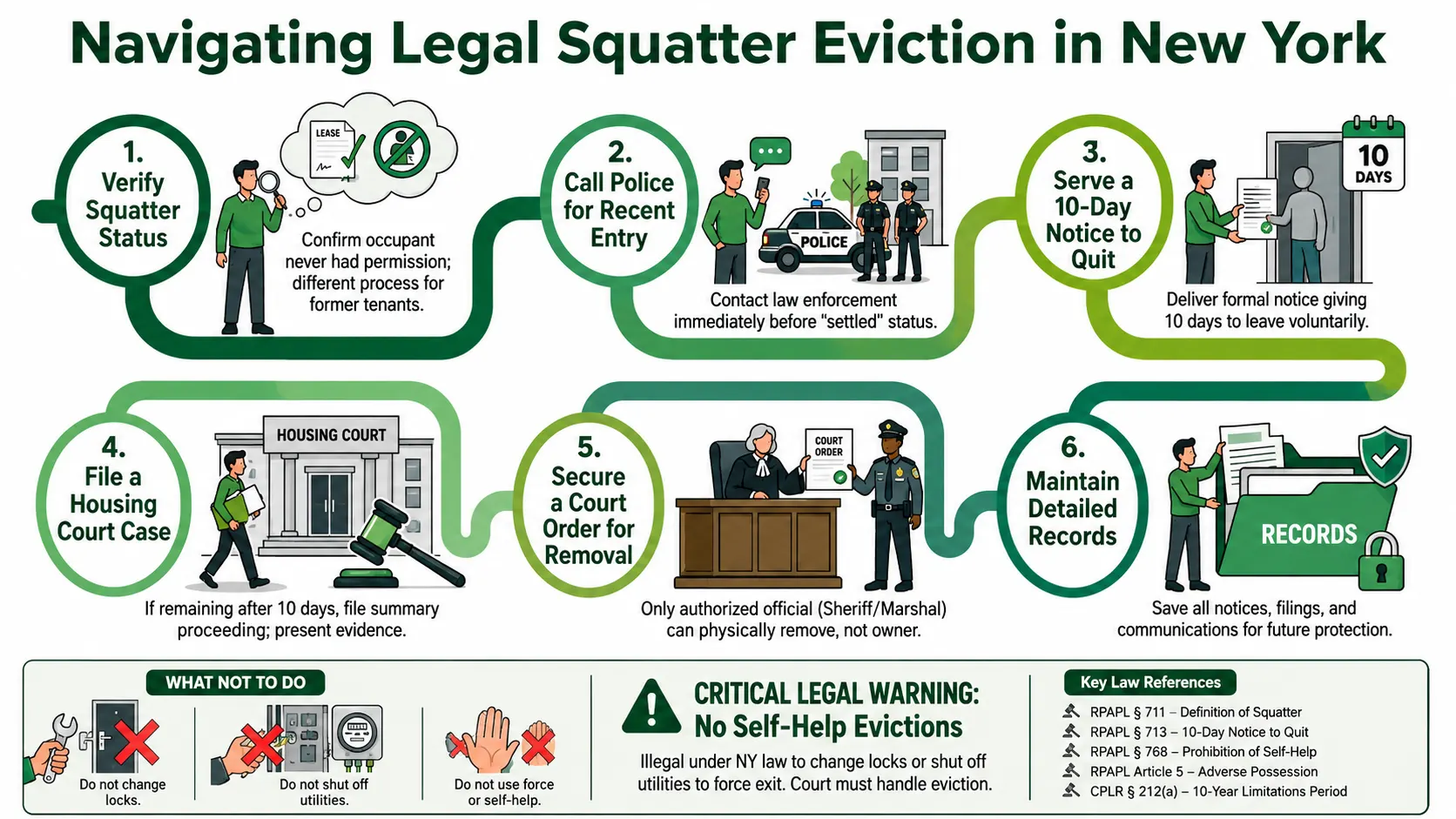
If you discover a squatter on your property, it is important to handle the situation the right way. Following the legal process can help you avoid delays and protect your rights as a property owner.
Step 1: Make Sure the Person Is Actually a Squatter
Start by figuring out who is occupying your property. Did they ever have your permission to live there?
If the answer is yes, they may be a tenant, former tenant, guest, or subtenant. In that case, you will usually need to follow the standard eviction process.
If they moved in without your permission, they are more likely to be considered a squatter.
Step 2: Contact the Police if the Occupation Is Recent
If you catch someone breaking into your property or moving in before they have settled, contact the police right away.
However, once someone has started living there, the situation often becomes a civil matter. In most cases, you will need to go through the court process instead of relying on law enforcement to remove them.
Step 3: Serve a 10 Day Notice to Quit
If the person is a squatter, the next step is to serve them with a 10 day Notice to Quit under New York law.
This notice gives the squatter a chance to leave the property voluntarily before you take the matter to court.
Step 4: File a Case in Housing Court
If the squatter does not leave after the notice period ends, you can file a summary proceeding in your local Housing Court or Civil Court.
Be ready to show evidence that the person never had permission to live on the property. This may include photos, security camera footage, property records, or other documents that support your claim.
Step 5: Get a Court Order for Removal
If the court rules in your favor, it will issue an order allowing the squatter to be removed.
Keep in mind that only a sheriff, marshal, or another authorized law enforcement officer can carry out the removal. Even if you win the case, you cannot remove the squatter yourself.
Step 6: Keep Good Records
Throughout the process, save copies of every notice, court filing, photo, email, and other important documents.
Good records can strengthen your case and help protect you if the squatter later claims they had permission to live on the property or tries to assert legal rights.
If the person turns out to be a holdover tenant rather than a true squatter, you will need to follow RentPost’s full tenant eviction process guide and our walkthrough of notices to vacate and eviction proceedings instead of the faster squatter process described above.
If you prefer a quick overview, the table below summarizes the typical legal process for removing a squatter in New York.
| Step | What Happens |
| Step 1 | Confirm the person is a squatter and not a tenant or holdover tenant. |
| Step 2 | Contact the police if the occupation is recent and the person has not established residency. |
| Step 3 | Serve a 10 Day Notice to Quit. |
| Step 4 | File a summary proceeding in Housing Court if the squatter does not leave. |
| Step 5 | Attend the court hearing and present evidence. |
| Step 6 | Obtain a court order for removal. |
| Final Step | A sheriff or marshal removes the squatter from the property. |
Can a Squatter Take Ownership of Your Property in New York?
This is one of the biggest concerns for landlords. The good news is that it is much harder than many websites make it sound.
In some cases, a squatter may try to claim ownership of a property through a legal process called adverse possession. However, this only applies in very limited situations and has strict legal requirements.
What Is Adverse Possession?
Adverse possession is a legal rule that allows someone to claim ownership of a property after occupying it for a long time without the owner’s permission. In New York, these rules are covered under RPAPL Article 5.
To have a valid adverse possession claim, the person must meet all of the following requirements for the entire 10 year period:
- They occupied the property without the owner’s permission.
- They believed they had a legal right to the property. Simply knowing you are trespassing is not enough under New York law.
- Their occupation was open and obvious. They could not hide the fact that they were living there.
- They lived on the property continuously for 10 years. Long gaps in occupancy can break the claim.
- They had exclusive control of the property. They could not share possession with the owner or the public.
- They actually used the property. They must have physically occupied and maintained it, not just claimed ownership on paper.
The 10 Year Rule
The statutory period required in New York is 10 years, under New York Civil Practice Law and Rules (CPLR) Section 212(a). This 10 year period applies statewide, whether the claim is based on a written instrument like a defective deed (RPAPL Section 511) or made without one (RPAPL Section 521).
If just one requirement is missing, or the occupancy is interrupted at any point during those 10 years, the claim will fail.
For most landlords, especially those who regularly inspect and manage their rental properties, successful adverse possession claims are very uncommon.
Common Myths About Adverse Possession
There is a lot of misleading information online. Here are two facts every landlord should know:
- Paying property taxes is not a legal requirement for an adverse possession claim in New York. While it may support a claim, it does not automatically give someone ownership rights.
- The 10 year requirement is the same across New York. It does not change based on where the property is located or where the owner lives.
The best way to protect your property is to inspect it regularly, respond quickly to unauthorized occupants, and take legal action as soon as you discover a squatter. Acting early can prevent small problems from becoming much bigger ones later.
What Happens If You Ignore a Squatter
Leaving a squatter unaddressed is one of the most expensive mistakes a New York property owner can make. The longer you wait, the more entrenched the occupant becomes, and the harder it can be to prove they never had permission to be there.
Practical risks of inaction include:
- Lost rental income for as long as the unit sits occupied without payment.
- Property damage from an occupant who has no incentive to maintain the space.
- A stronger adverse possession claim the longer the occupation continues, since continuity is one of the required elements.
- Potential liability if the property becomes unsafe or a fire or safety hazard develops while occupied.
How to Prevent Squatters From Moving Into Your New York Rental
Prevention is far less expensive than removal. If you own vacant property in New York, especially in New York City where turnover happens quickly, build these habits into your property management routine.
- Inspect vacant units at least every two to four weeks, more often if the property has a history of break ins.
- Secure all entry points, including basement windows and unused doors, immediately after a tenant moves out.
- Change the locks between tenants so a previous occupant or their guests cannot re-enter.
- Post “No Trespassing” signage, which under New York Penal Law helps establish that entry is unauthorized.
- Keep utilities connected or clearly document that the unit is intentionally vacant, since a property that looks abandoned attracts squatters faster.
- Use a property management platform to track vacancy dates, inspection schedules, and maintenance requests so nothing falls through the cracks between tenants.
The Bottom Line
New York squatters rights are real, but they are also frequently misunderstood. The 2024 change to RPAPL Section 711 removed the automatic 30 day tenant protection for true squatters, giving property owners a faster path to removal. Adverse possession, the process by which a squatter could actually gain ownership, requires 10 full years of continuous, exclusive, and open occupation, and fails if even one element is missing.
If you discover a squatter in your New York property, do not attempt to remove them yourself. Confirm their status, serve the proper notice, and work through the Housing Court process, or speak with a landlord-tenant attorney who can guide you through your specific situation.
Frequently Asked Questions About Squatters Rights in New York
How long does a squatter have to stay in New York before they get rights?
Simply staying for 30 days does not grant tenant rights if the person never had permission to be there, following the 2024 change to RPAPL Section 711. To gain ownership through adverse possession, an occupant must meet all six legal elements continuously for 10 years under CPLR Section 212(a).
Can I call the police to remove a squatter in New York?
Police can remove someone as a trespasser if you catch them before they establish occupancy. Once a person has settled in, police typically treat it as a civil matter and require you to go through the courts, even after the 2024 law change.
Is it legal to change the locks on a squatter in New York?
No. Self-help evictions, including changing locks or shutting off utilities, are illegal under RPAPL Section 768 and can result in civil and criminal penalties against the property owner.
What is the difference between a squatter and a holdover tenant in New York?
A squatter never had permission to be on the property. A holdover tenant originally had lawful permission, such as a lease or verbal agreement, and simply stayed past the end of that permission. Holdover tenants must go through the standard eviction process, while squatters can be removed through the faster RPAPL 713 process.
How long does it take to legally remove a squatter in New York?
Timelines vary by county and court backlog, but landlords should generally expect the process, from the 10 day notice to quit through a court order, to take several weeks to a few months.
Author