Log in
 Free Trial
 jacob-thomason
  176 views
  0
0
Property management companies now play a major role in handling rental properties, commercial buildings, maintenance operations, tenant communication, and financial management.
Rising rental demand, growing housing inventories, and increasing use of AI tools continue to shape the industry in 2026.
The latest property management statistics show strong market growth across the United States and global regions. The data also highlights how software adoption, rising operational costs, and changing renter behavior are affecting property managers and landlords.
We conducted deep online research and collected the latest property management statistics from trusted industry reports, government data, market research studies, and company insights. For detailed reference, all sources are attached at the end of the article.
In this article, we will cover the latest property management statistics for 2026, including market size, software adoption, rental housing trends, maintenance costs, tenant behavior, and industry growth forecasts.
Key Property Management Statistics 2026
- The US property management market may reach $127.21 billion in 2026.
- Nearly 333,400 property management companies operate in the United States.
- Around 68% of North American property managers use property management software.
- AI adoption among property managers increased from 21% to 34% in one year.
- The US rental vacancy rate reached 7.3% in Q1 2026.
- Property owners lose up to $3,872 for each vacant rental unit.
- Nearly 75% of property managers plan to grow their business in 2026.
- Residential properties account for 49.35% of the US property management services market.
Property Management Market Size and Industry Growth Statistics
The property management industry is growing as more landlords, investors, and businesses depend on professional management services. Market expansion, rising rental demand, and business growth plans continue to shape the industry in 2026.
- According to Modor Intelligence, the US property management market may reach nearly $127.21 billion in 2026 and could grow to around $184.25 billion by 2033 with a 5.4% annual growth rate.
- Another industry estimate from Grand View Research places the US property management market at $88.03 billion in 2026, with projections showing growth to $106.58 billion by 2031.
- More than $130 billion in yearly revenue comes from the US property management industry.
- Between 2025 and 2030, the global property management market may expand by nearly $14.47 billion at a CAGR of 8.5%.
- Business expansion remains a major focus in 2026, with nearly 75% of property managers planning to grow their operations further.
- Revenue growth is expected by 94% of property management companies over the next two years.
- Many companies are also broadening their offerings, as 40% of property management firms plan to expand their services in the coming years.
- The number of property types managed may also increase, as 33% of companies plan to expand into additional categories.
Property Management Companies and Business Operations Statistics
Property management companies handle rent collection, maintenance work, tenant communication, inspections, and daily property operations. The industry also continues to face challenges related to staffing, payments, and operational costs.
- The United States currently has nearly 333,400 active property management companies operating across residential and commercial sectors.
- Residential property management dominates the market, with 238,000 residential firms operating out of roughly 304,000 total property management businesses in the country.
- More than half of property owners now hire professional property managers instead of managing properties on their own.
- Most property management companies charge between 8% and 12% of monthly rental income as their management fee.
- Late rent payments remain a major issue, and 41% of property managers list it as one of their biggest operational challenges.
- Maintenance coordination takes a large amount of time, with 39% of property managers spending over 20 hours every month handling maintenance requests.
- For many landlords, technology adoption remains expensive, around 35% say software and technology costs are the biggest barriers to using new property management tools.
Property Management Software and AI Adoption Statistics
Property management companies now use software tools to manage rent collection, accounting, maintenance requests, tenant records, and communication. AI adoption is also growing as companies look for faster and more automated workflows.
- According to Fortune Business, the global property management software market could grow from $29.19 billion in 2026 to nearly $61.41 billion by 2034.
- Grand View Research forecast market estimates the property management software industry at $3.81 billion in 2026, with growth reaching $5.89 billion by 2033.
- Property management software has already become widely used in North America, where 68% of property managers now rely on these tools for daily operations.
- AI adoption among property managers increased sharply from 21% in 2024 to 34% in 2025.
- Globally, property managers account for 35.2% of the total property management software market share by end users.
- In the United States, property managers hold 37.5% of the software market share among end users.
- Globally,, real estate agents account for another 31.5% share of the US property management software market.
Regional Property Management Software Market Statistics
Property management software adoption is increasing across North America, Europe, Asia Pacific, and other global regions as real estate companies continue investing in digital tools, automation, and cloud based management systems.
- North America remains the largest regional market, reaching nearly USD 9.32 billion in 2025 and projected to grow to USD 10.13 billion in 2026.
- Europe accounted for more than 27% of the global market in 2025, with total market value expected to rise from USD 7.26 billion to USD 7.92 billion in 2026.
- The Asia Pacific region represented 27.1% of global demand in 2025 and may grow from USD 7.2 billion to USD 8.08 billion in 2026.
- Property management software demand in the Middle East and Africa reached USD 1.55 billion in 2025 and could increase to USD 1.73 billion in 2026.
- Latin America held nearly 4.6% of the global market in 2025, with revenue expected to grow from USD 1.21 billion to USD 1.33 billion in 2026.
- Within the United States, the Southeast region generated 20.1% of total property management market revenue in 2025.
- The Western US market is also expanding steadily and may grow at a CAGR of 4.93% through 2031.
US Rental Housing and Tenant Statistics
Rental housing demand in the United States remains strong in 2026 as millions of people continue living in apartments, rental homes, and multifamily properties. Rising rents, long term renting trends, and growing housing supply are also shaping the rental market.
- Nearly 27% of adults in the United States currently live in rental housing instead of owning a home.
- The country now has around 46.1 million rental households, creating strong demand for property management services.
- Rental vacancy rates in the United States reached 7.3% during the first quarter of 2026.
- Single-family rentals continue to grow in popularity, with nearly 18% of America’s single family homes now used as rental properties.
- Long-term renting has become more common, and 36% of renters stay in the same unit for at least five years.
- Long-term renting is especially common in New York City, where 53.3% of renters continue living in rental housing for extended periods.
- The United States added more than 600,000 new apartment units in 2024, marking the highest level of apartment construction seen in decades.
- Over the last five years, rent prices across the United States increased by nearly 32%, adding more pressure on renters and property owners.
- Insurance expenses also increased sharply during the same period, with costs rising by around 26% for property owners and landlords.
Property Type, Services, and Maintenance Statistics
Different property types and service categories continue to shape the property management industry. Residential properties still hold the largest market share, while commercial management and compliance services are growing steadily. At the same time, maintenance and vacancy costs continue to affect property owners and managers.
- Residential properties held 49.35% of the US property management services market share in 2025, making it the largest property segment in the industry.
- Commercial property management is expected to grow at a CAGR of 4.82% through 2031 as demand for managed office and retail spaces increases.
- Tenant and resident-related services generated 34.12% of total market revenue in 2025.
- Compliance and legal support services are also growing and may expand at a CAGR of 4.6% through 2031.
- Property owners lose an average of $1,750 every time a tenant moves out of a rental unit.
- Vacancy losses can become even higher, with landlords losing between $1,750 and $3,872 for every empty rental property.
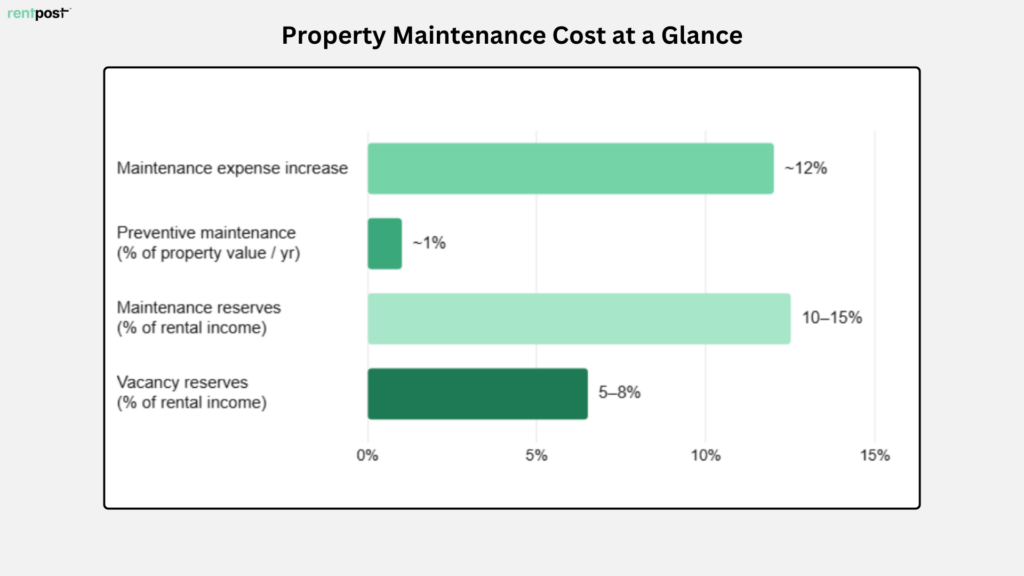
- Property maintenance expenses increased by nearly 12% in recent years due to rising labour and material costs.
- Preventive maintenance alone costs property owners around 1% of the property’s value every year.
- Maintenance reserves usually consume between 10% and 15% of rental income, while vacancy reserves take another 5% to 8%.
Simplify Property Management with RentPost
The property management industry continues to grow as rental demand, housing development, and technology adoption increase across the market. Companies are investing more in software tools, AI powered systems, maintenance services, and tenant management solutions to improve operations and reduce manual work.
The latest statistics also show that property managers face rising costs, operational pressure, and changing renter expectations in 2026. As rental portfolios grow larger, many landlords and property managers now rely on property management software to handle maintenance requests, tenant communication, accounting, leasing, and reporting more efficiently.
RentPost property management software helps simplify rental management with features like online payments, tenant screening, maintenance tracking, accounting, reporting, and communication tools in one platform. Whether you manage a few rental units or a large property portfolio, the platform can help reduce manual work and make daily property management easier.
Data Sources
- https://www.marketresearch.com/Infiniti-Research-Limited-v2680/Global-Property-Management-44522275/
- https://www.fortunebusinessinsights.com/property-management-market-102805
- https://www.grandviewresearch.com/industry-analysis/property-management-software-market
- https://www.grandviewresearch.com/industry-analysis/us-property-management-services-market-report
- https://www.mordorintelligence.com/industry-reports/us-property-management-market
- https://www.revenuememo.com/p/property-management-industry-statistics
- https://www.census.gov/housing/hvs/files/currenthvspress.pdf
- https://www.amerisave.com/learn/managing-rental-properties-in-essential-strategies-every-landlord-needs
- https://www.resiclubanalytics.com/p/share-each-state-single-family-homes-that-are-single-family-rentals-batchdata
- https://flatfeelandlord.com/blog/how-overlooked-expenses-eat-into-your-rental-property-profits
- https://nypost.com/2026/03/26/real-estate/americas-most-expensive-metros-are-becoming-affordability-traps-for-long-term-renters/
Author