Log in
 Free Trial
 karina
  Updated on July 14, 2026
  283 views
  0
0
Someone moves into an empty house. They do not pay rent. They do not own the place. Yet the police will not simply drag them out. How is that even possible?
Squatter rights are legal rules that can allow a person who lives in a property they do not own to gain certain protections, and, in rare cases, even ownership. The formal name for this is adverse possession. A squatter cannot claim these rights overnight. They must occupy the property in a specific way for a set number of years, and that number varies by state.
This guide explains what squatter rights are, why they exist, how they differ from trespassing, and what the new 2024 and 2025 state laws changed. You will also learn how to keep your property safe. Everything here is written in plain English, so you do not need a law degree to follow it.
What Are Squatter Rights?
Squatter rights, known in law as adverse possession, allow a person to claim legal ownership of property they do not hold title to, if they occupy it openly and continuously for a period set by state law. That is the short answer.
According to the Cornell Legal Information Institute, the person must possess the property in the way a true owner would, without the real owner’s permission. The doctrine does not apply to property owned by the government. It applies to private land and buildings.
Here is the part that surprises most people. A squatter does not gain any rights on day one. In the beginning, they are simply occupying property unlawfully. Rights only build up slowly, over many years, and only if strict conditions are met the entire time.
Definition
In the United States, squatter rights are laws that may allow a person living on a property without permission to seek ownership through adverse possession, but only if they satisfy strict rules set by the state.
Why Do Squatters Have Any Rights at All?
This is the question most property owners ask first. Why would the law ever reward someone for living in a home they do not own?
The idea is centuries old. Adverse possession was created to encourage the use of land rather than leaving it to rot, and to settle old disputes over who really owns a piece of property. If land sat abandoned for decades and someone else cared for it, farmed it, and treated it as their own, courts eventually recognized that use. The rule also protects honest buyers who took over land in good faith, for example, when an old fence was placed a few feet over a boundary line by mistake.
So the goal was never to help modern squatters take over family homes. The goal was to reward productive use and to bring certainty to messy property records. The problem is that the same old doctrine has sometimes been invoked by people who deliberately move into vacant homes. That mismatch is exactly why so many states rushed to change their laws in 2024 and 2025, which you will read about below.
Squatter, Trespasser, or Holdover Tenant?
These three terms get mixed up constantly, and the difference matters. The wrong label can send you down the wrong legal path. Here is how they compare.
| Type | Who they are | What the law usually does |
|---|---|---|
| Squatter | Lives in a vacant or abandoned property without permission and acts like an owner. | May build an adverse possession claim over years if conditions are met. |
| Trespasser | Enters property without permission but does not live there or act as owner. | Gains no ownership rights. Often a criminal matter. |
| Holdover tenant | A former renter who stays after the lease ends. | Had permission at one time, so a formal eviction is usually required. |
Why the holdover tenant case is different
A holdover tenant is not a squatter. That person once had a signed lease and your permission to live there. Because permission existed, courts treat them as a tenant, not an intruder. To remove a holdover tenant you almost always have to follow the normal court process. You can read the full steps in our guide to the tenant eviction process.
The Five Requirements for a Squatter to Claim Ownership
A squatter cannot simply wait out the clock. To even attempt an adverse possession claim, courts across the United States generally require all of the following. The Cornell Legal Information Institute and long standing case law describe these elements clearly.
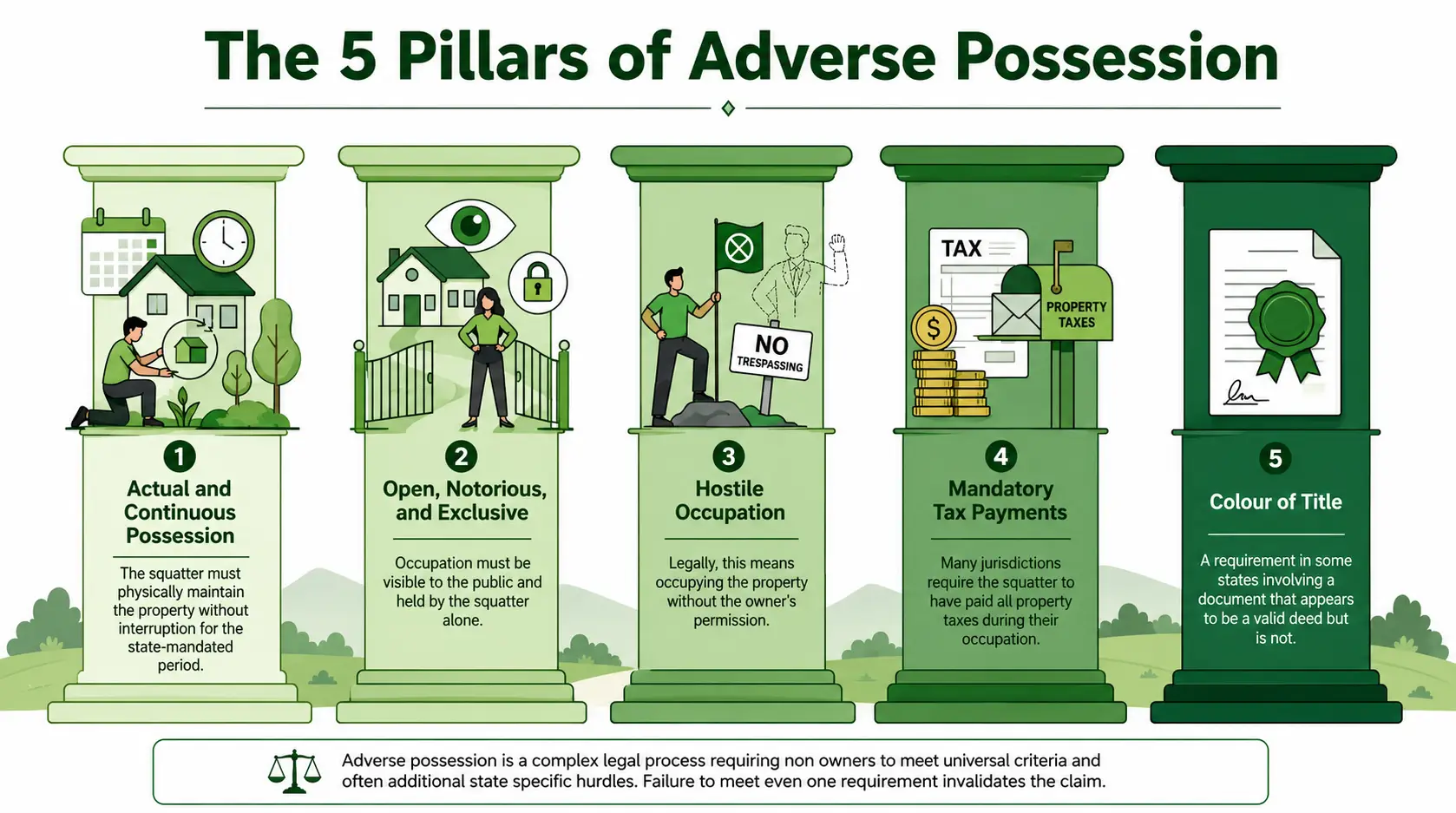
- Actual possession. The person must physically use the property the way a real owner would, such as living in it and maintaining it.
- Open and notorious. The use must be obvious, not hidden. A neighbor or the owner should be able to see it. You can read more about this element from Nolo.
- Exclusive. The squatter must possess the property alone, not share it with the true owner or the public.
- Hostile. In law, hostile does not mean angry or violent. As the Cornell Legal Information Institute explains, it simply means the person occupies the property without the owner’s permission.
- Continuous. The possession cannot stop and start. It must run without interruption for the full number of years the state requires.
Many states add more hurdles. Some require the squatter to pay property taxes for the entire period. Some require a document called color of title, which is a faulty deed that appears valid but is not. If even one requirement fails, the claim fails.
How Long Before a Squatter Can Claim a Property?
There is no single national answer. Each state sets its own time period, and the range is wide. According to the Cornell Legal Information Institute, a typical statute requires 7 years of possession under color of title, or 20 years without it, but many states are shorter or longer. Here are a few real examples.
| State | Time period for a claim | Notable condition |
|---|---|---|
| California | 5 years | Squatter must pay property taxes for the full 5 years. |
| New York | 10 years | Law now states squatters are not tenants at any time. |
| Florida | 7 years | Requires taxes or color of title, and removal is now much faster. |
| Georgia | 20 years, or 7 with color of title | New law lets owners trigger fast removal of recent squatters. |
Because the numbers vary so much, you should always confirm the current rule in your own state before you act. State specific pages, such as our California landlord and tenant rights guide, break down local timelines and notice rules in detail.
The 2024 and 2025 Squatter Law Changes You Need to Know
This is the biggest recent shift, and many older articles still miss it. After a wave of viral cases where owners could not quickly remove people from their homes, a long list of states passed new laws in 2024 and 2025. These laws did not erase adverse possession. Instead, they created a fast track for removing recent, opportunistic squatters before any long term clock can start.
- Florida: House Bill 621, effective July 1, 2024, and later codified in the state statutes, lets an owner file a complaint with the sheriff to have unauthorized occupants removed quickly. It also created criminal penalties, including a felony for presenting a fake lease.
- Georgia. The Georgia Squatter Reform Act, signed in April 2024, requires anyone accused of squatting to show proof of legal residency within three days or face arrest.
- New York:The 2025 state budget changed squatter rights in New York by making it clear that squatters are not considered tenants, regardless of how long they have occupied a property. Previously, someone who remained on a property for 30 days could potentially be treated as a tenant under state law.
- West Virginia, Tennessee, and Alabama. Each passed 2024 laws that treat squatting as criminal trespass and let law enforcement remove occupants without a full eviction.
- Idaho, Louisiana, Maryland, and North Carolina. In 2025 these states added sheriff based removal processes and faster court hearings for unauthorized occupants.
Also Read: Complete Guide to Massachusetts Squatters’ Rights
Important Distinction
These new laws speed up removal of recent squatters. They do not wipe out true adverse possession claims that have already built up over many years. Long-term claims are still decided under each state’s older property statutes and court decisions.
How to Protect Your Property From Squatters
The best defense is to never leave an opening. Squatters look for vacant, poorly watched properties. A few simple habits remove most of the risk.
- Inspect vacant units often, and do not let a property sit empty and silent for weeks.
- Lock every door and window, and consider a basic alarm or camera system.
- Post clear No Trespassing signs, which strengthen your legal position later.
- Keep the yard and exterior maintained, so the property does not look abandoned.
- Collect mail or forward it, since a pile of mail signals a vacant home.
Strong screening also keeps risky occupants out from the start. Careful tenant screening helps you verify who you are handing keys to, so you avoid problem occupants and holdover disputes down the road.
What to Do If Someone Is Already Squatting
If you find a person living in your property, stay calm and do not try to force them out yourself. Courts call this self help, and it is illegal in every state.
- Do not change the locks while the person is inside.
- Do not shut off water, power, or heat.
- Do not remove their belongings or threaten them.
Any of these moves can actually help the occupant in court and expose you to a lawsuit. Instead, document everything, call your local law enforcement to ask whether the new fast removal process applies, and follow the proper legal steps. For a lawful, court backed removal, review our full eviction process guide and speak with a local attorney if the situation is unclear.
The Bottom Line
Squatter rights sound scary, but they are far narrower than headlines suggest. Adverse possession takes years and strict conditions, and the newest state laws have shifted power back toward property owners. Your strongest protection is prevention. Watch your vacant units, screen your applicants well, and act through the proper legal channels the moment you spot a problem. Do that, and squatter rights will stay a topic you read about rather than one you live through.
Legal Disclaimer
This article is provided for general informational purposes only and does not constitute legal advice. Property law, squatter rules, and adverse possession requirements are governed by state statutes and vary significantly by location, and they change over time. The summaries here may not reflect the most current law in your state or the specific facts of your situation. For guidance on a real situation, consult a licensed attorney in your state.
Frequently Asked Questions About Squatter Rights
What does squatter rights mean in simple terms?
Squatter rights, or adverse possession, are the legal rules that can let someone who lives in a property they do not own gain protections, and in rare cases ownership, after occupying it openly and continuously for the number of years their state requires.
Are squatter rights real or a myth?
They are real, but they are widely misunderstood. Adverse possession is a genuine legal doctrine. However, a squatter must meet strict conditions over many years, and new 2024 and 2025 laws in many states make it much easier for owners to remove recent squatters fast.
Is squatting the same as trespassing?
No. A trespasser enters property without permission but does not live there and gains no ownership rights. A squatter actually occupies the property and lives in it as if they owned it, which is what can, over a long time, lead to an adverse possession claim.
How long does a squatter have to stay to claim a house?
It depends entirely on the state. California requires 5 years, New York requires 10 years, and Florida requires 7 years, while a common default is 20 years without color of title. Always confirm the current rule in your own state.
Can I remove a squatter by myself?
No. Changing locks, cutting utilities, or removing belongings is called self help and is illegal everywhere. You must use the lawful process, which may include a fast sheriff based removal in some states or a formal court action in others.
Author