Log in
 Free Trial
 karina
  Updated on August 11, 2026
  530 views
  0
0
Whether you are renting your first home or preparing to lease out a property, the lease agreement is one of the most important documents you will deal with. It sets clear expectations for both the landlord and tenant before the tenancy begins.
A lease agreement is a legally binding contract that gives a tenant the right to occupy a rental property for a specified period in exchange for rent. It also outlines important terms such as the rent amount, security deposit, maintenance responsibilities, property rules, and conditions for ending the tenancy.
But what exactly should a lease agreement include? How is it different from a rental agreement? And what happens if a landlord or tenant breaks the terms? This guide explains everything you need to know about lease agreements in plain English, whether you are creating one, signing one, or simply trying to understand your rights and responsibilities.
Key Takeaways
- A lease agreement is a legally binding contract between a landlord and tenant that defines the terms of a rental arrangement.
- It typically covers the lease term, rent, security deposit, maintenance responsibilities, property rules, and termination conditions.
- A fixed-term lease provides greater stability, while a month-to-month rental agreement offers more flexibility.
- Lease requirements and termination rules can vary by state and local law.
- Rent-to-own and lease-option agreements include additional terms that are different from a standard lease.
What Is a Lease Agreement?
A lease agreement is a written contract between you as a landlord and your tenant. It spells out the rent, the length of the tenancy, and the rules both of you agree to follow. Once you both sign it, it is legally binding. Neither of you can walk away from its terms without consequences.
Under property law, a lease does two things at once. It creates a contract, and it hands the tenant a temporary legal interest in the property called a leasehold estate. You keep ownership. Your tenant gets exclusive use of the unit for the lease term.
A written lease is not just paperwork. It is your evidence if a dispute ever lands in front of a judge. A verbal agreement leaves you guessing about what either side actually promised.
What Does a Lease Agreement Look Like?
If you’ve never seen a lease agreement, it may seem like a long and complex legal document. In reality, most lease agreements follow a similar format. They begin by identifying the landlord, tenant, and property, then outline important details such as the lease term, rent amount, security deposit, maintenance responsibilities, and rules both parties must follow.
The example below shows what a typical lease agreement looks like and highlights some of the key sections you’ll find in most residential and commercial leases.
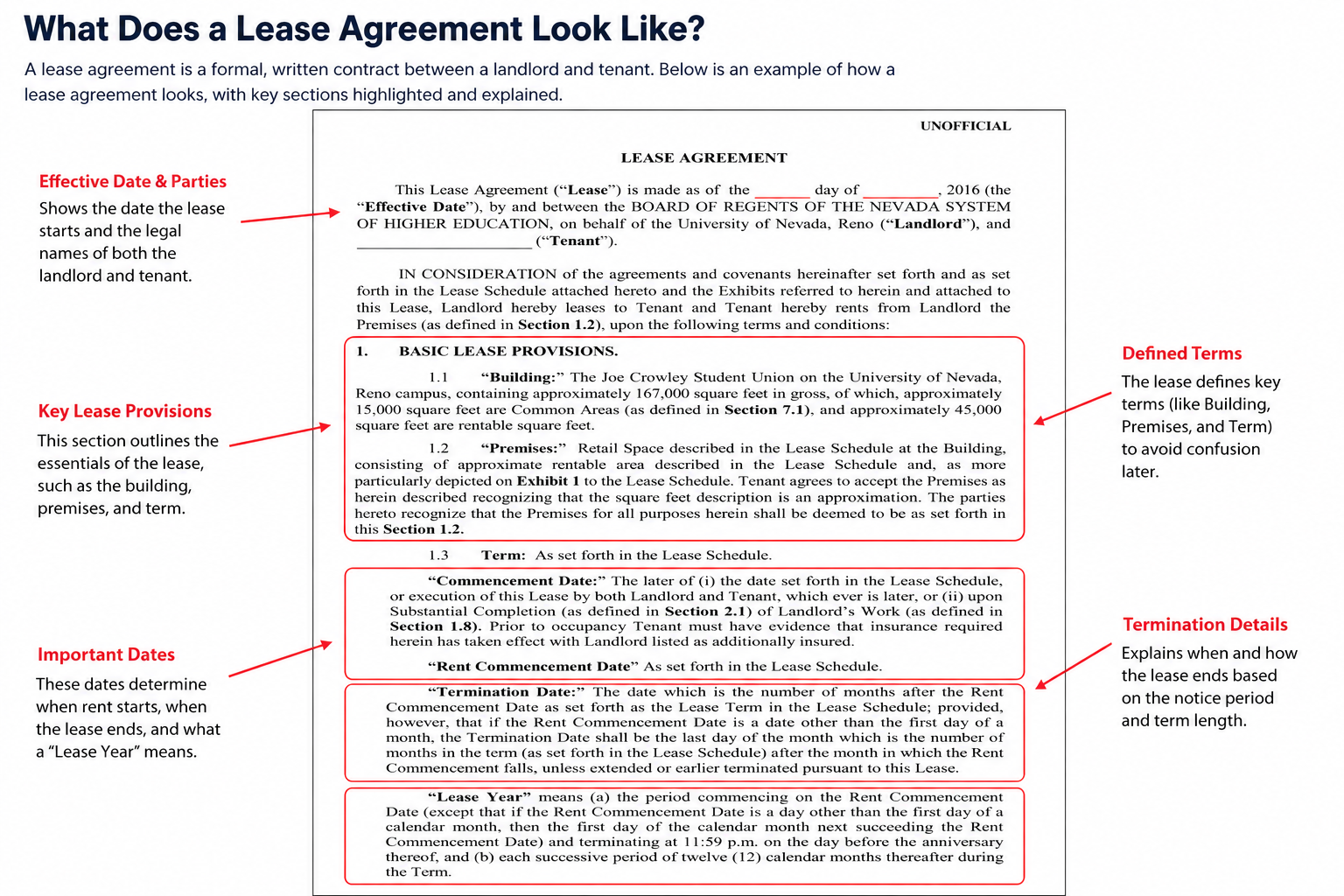
Source: University of Nevada, Reno – Sample Lease Agreement (PDF)
Types of Lease Agreements
Not every lease works the same way. The right agreement depends on the property, the length of the tenancy, and the needs of the landlord and tenant. Common types of lease agreements include:
Fixed-term lease: Has a specific start and end date, often lasting six or 12 months. The rent and other terms generally remain in effect throughout the agreed term unless the lease or applicable law allows changes.
Month-to-month lease: Renews automatically each month until the landlord or tenant gives the required notice. This arrangement offers more flexibility but may provide less long-term stability. Review the pros and cons of a month-to-month lease before choosing this structure.
Joint lease: Allows multiple tenants to rent the same property under one agreement. Depending on the lease terms, tenants may have joint and several liability, meaning each tenant may be responsible for the full rent and other lease obligations if another tenant fails to pay. Learn more about joint and several liability leases before signing a lease with roommates or co-tenants.
Commercial lease: Used for business properties and typically includes additional terms covering permitted use, insurance, maintenance, taxes, and other commercial responsibilities.
Lease-option (rent-to-own): Combines a standard lease with an option for the tenant to purchase the property later. Because this arrangement involves additional legal and financial considerations, it should be reviewed separately from a standard residential lease.
Lease Agreement vs. Rental Agreement: What Is the Difference?
The terms “lease agreement” and “rental agreement” are often used interchangeably, but they can describe different rental arrangements. A lease agreement generally covers a fixed period, while a rental agreement often refers to a month-to-month arrangement that renews automatically.
| Feature | Lease Agreement | Rental Agreement |
|---|---|---|
| Term length | Fixed, often six or 12 months | Usually month-to-month |
| Rent changes | Generally remains fixed during the term | May change with proper notice |
| Ending the agreement | Usually requires the parties to follow the lease’s termination terms | Either party can generally end the arrangement with the required notice |
| Flexibility | Less flexible but provides greater stability | More flexible but may provide less long-term certainty |
The exact rules depend on the agreement and applicable state or local law. If you are creating a month-to-month rental arrangement, review the essential terms a rental agreement should include before signing.
A fixed-term lease may be preferable when both parties want predictable terms for a defined period. A month-to-month rental agreement may be more suitable when flexibility is a priority.
What Makes a Lease Legally Valid
For a lease to hold up in court, it needs four things in place:
Legal capacity: Both you and your tenant must be legally able to enter a contract (of legal age, of sound mind).
Mutual agreement: You both agree on the essential terms — rent, dates, the unit itself.
Lawful purpose: The lease can’t be used for an illegal purpose.
Consideration: Rent is exchanged for occupancy — money changes hands for a real right to use the property.
Miss one of these and the lease can be challenged. That’s why vague or handshake terms cause so many landlord-tenant disputes, the agreement was never fully formed in the first place.
What a Lease Agreement Should Include
A solid lease answers every question before it becomes a fight. At minimum, yours should cover:
| Section | What It Should Cover |
| Parties and property | Full legal names of all tenants, plus the property address and unit number |
| Lease term | Start date, end date, and what happens at renewal |
| Rent details | Amount, due date, accepted payment methods, late fees, and any grace period |
| Security deposit | Amount, where it’s held, and the conditions for its return |
| Maintenance | Who handles repairs, lawn care, and pest control and how tenants submit requests |
| Utilities | Which are included in rent and which the tenant pays directly |
| Right of entry | When and why you can enter the unit, and the notice you must give |
| Rules and restrictions | Pets, subletting, occupancy limits, smoking |
| Termination terms | Notice required to end the lease and any early-termination penalty |
A lease agreement is usually only one part of the paperwork involved in managing a rental property. Depending on the arrangement, landlords may also use move-in and move-out inspection forms, maintenance request forms, lease addendums, rent records, and security deposit documentation. See our guide to property management forms and paperwork for more information about the documents commonly used throughout a tenancy.
How to Write a Lease Agreement
Writing a lease agreement involves clearly documenting the terms that govern the rental relationship. While requirements vary by state and locality, a basic residential lease generally includes:
- Identify the parties: Include the legal names of the landlord, tenant, and any other parties who have rights or responsibilities under the agreement.
- Describe the property: State the complete rental property address and unit number, along with any included spaces or amenities.
- Set the lease term: Specify the start date, end date, and any renewal provisions.
- State rent and payment terms: Include the monthly rent, due date, accepted payment methods, late fees, and applicable grace periods.
- Explain the security deposit: State the deposit amount and the conditions governing its use and return.
- Define responsibilities: Clarify who is responsible for utilities, maintenance, repairs, lawn care, and other property-related duties.
- Add rental rules: Include applicable policies for pets, smoking, guests, subletting, occupancy, and other restrictions.
- Include termination terms: Explain how either party can end the agreement and what notice is required.
- Add required disclosures: Include any disclosures required under applicable federal, state, or local law.
- Review and sign: Both parties should carefully review the agreement and sign it before the tenancy begins.
Because lease requirements vary by location, landlords should verify applicable state and local requirements before using a lease agreement.
What Happens If Someone Breaks a Lease Agreement?
A lease agreement is a legally binding contract, so both landlords and tenants are expected to follow its terms. If either party violates the agreement, there can be financial, legal, or contractual consequences depending on the nature of the breach and applicable state laws.
Unpaid rent: A tenant who stops paying rent may owe the unpaid balance, late fees, and other costs allowed under the lease or state law, and may face the eviction process.
Early move-out: Leaving before the lease ends without a valid legal reason may result in early termination fees or continued rent obligations until the property is re-rented, depending on state law.
Lease violations: Breaking rules related to pets, unauthorized occupants, property damage, or other lease terms can lead to penalties or a formal notice to vacate.
Landlord breaches: If a landlord fails to provide a habitable property or ignores legally required repairs, tenants may have remedies such as requesting repairs, terminating the lease, or pursuing other rights available under state law.
Discriminatory lease terms: Lease agreements must comply with the Fair Housing Act, which prohibits discrimination based on race, color, religion, sex, national origin, familial status, or disability , see our overview of basic tenant rights.
The specific legal action that follows a lease violation depends on the circumstances and state law. It may include formal notices, financial claims, lease termination, or eviction proceedings, making it important for both landlords and tenants to understand their rights and obligations before taking action.
How Does Lease Renewal Work?
A lease renewal allows a landlord and tenant to continue the rental relationship after the original lease term ends. Depending on the lease and applicable law, the parties may sign a new fixed-term lease, renew the existing agreement, or allow the tenancy to continue on a month-to-month basis.
Before renewing, both parties should review the rent amount, lease term, maintenance responsibilities, renewal conditions, and any changes to the original agreement. Landlords may also consider the tenant’s payment history, rental performance, and other relevant factors when deciding whether to renew.
A tenant’s credit history can be one factor in a renewal decision, but it should be considered alongside the tenant’s actual rental payment history and other relevant circumstances. For more information, see our guide to renewing a lease for tenants with credit issues.
State Lease Laws: Written Lease Requirements and Notice Periods
Lease laws vary by state, so it’s important to understand your local requirements before signing or drafting a lease agreement. While the specific rules differ, two areas vary the most:
- Whether a lease agreement must be in writing
- How much notice is required to terminate a month-to-month lease
For example, Florida law requires lease agreements longer than one year to be in writing under the state’s Statute of Frauds, see our full breakdown of Florida rent increase laws for related rules. A month-to-month tenancy generally requires 15 days’ written notice before termination, while a week-to-week tenancy requires 7 days’ notice — see our full guide on 30 and 60-day notice rules.
Because notice periods, security deposit rules, and landlord-tenant laws differ across states, always verify the latest requirements through your state’s housing authority or HUD before creating or signing a lease agreement. This is especially important for landlords who manage rental properties in multiple states.
Lease Agreement vs. Rent-to-Own Agreement
Although they are often discussed together, a rent-to-own agreement is different from a standard lease agreement. Instead of being a separate legal category, it is a traditional lease that includes an option or obligation for the tenant to purchase the property in the future.
There are two common types of rent-to-own agreements:
Lease-option agreement: Gives the tenant the option, but not the obligation, to buy the property before the lease expires.
Lease-purchase agreement: Requires the tenant to purchase the property according to the terms outlined in the agreement.
In both arrangements, the lease portion still governs the tenancy. That means the agreed-upon rent, maintenance responsibilities, lease term, and termination rules remain in effect throughout the rental period.
Also Read: Lease to Own vs Lease Purchase: Key Differences
Final Thoughts
Understanding what a lease agreement is and how it works is essential for both landlords and tenants. From choosing the right type of lease to knowing what should be included, understanding your legal obligations can help you avoid disputes and protect your interests.
Before signing any lease agreement, review the terms carefully, verify your state’s legal requirements, and ensure the contract accurately reflects the rental arrangement. A comprehensive lease agreement not only safeguards your rights but also creates a clear framework for a successful tenancy.
Frequently Asked Questions
Is a lease agreement the same as a rental agreement?
Not exactly. “Lease agreement” usually refers to a fixed-term contract, while “rental agreement” usually refers to a month-to-month tenancy. Both are legally binding once signed.
Does a lease have to be in writing to be valid?
It depends on your state and the lease length. Many states require written leases for terms over one year, while shorter verbal leases may be enforceable but are much harder to prove in a dispute.
Can a landlord change the terms of a lease mid-term?
Generally, no. Once signed, the terms are locked for the length of the lease unless both parties agree in writing to an amendment.
What is the difference between a lease agreement and a rent-to-own agreement?
A rent-to-own agreement is a lease with an added right, or obligation, to purchase the property later. A standard lease has no purchase component at all.
Legal Disclaimer
This article is for general informational and educational purposes only and should not be considered legal advice. Lease requirements vary significantly by state and locality. Before signing or drafting a lease agreement, consult a qualified real estate attorney or your state’s housing authority to confirm current requirements in your area.
Author