Log in
 Free Trial
 karina
 Updated on October 28, 2026
 2202 views
 3

Raising rent is often a sensitive issue between landlords and tenants. Many states set limits to keep housing affordable while still allowing property owners to earn a fair return. Florida takes a different approach: the state does not set a fixed cap on how much a landlord can raise rent.
For decades, rental prices have risen and fallen freely based on supply and demand in the Florida housing market rather than on factors such as inflation rates. While Florida experienced one of the highest percentage drops in the cost of rentals in 2023, average rent was still higher than the national median by over 15 percent in mid-2024.
This article explains Florida rent control rules and the rent increase laws that apply in 2026: how much a landlord can raise rent in Florida, how much notice is required, and what legal limits actually apply.
- How much can you raise rent in Florida?
- What is the rent cap in Florida?
- Florida rent increase laws for 2026
- How often can a landlord raise rent in Florida?
- Rent increase notice in Florida by government
- Single family home rent increase Florida
- Does Florida have rent control?
- Can a landlord raise rent more than 10% in Florida?
- What are the new rental laws in Florida?
- How to manage your rental property and rent collection
Key points about Florida rent increase laws
- There is no fixed percentage limit on rent increases in Florida; the amount depends on market conditions
- Under Florida rent increase laws, landlords can raise rent by any amount if they follow the notice rules
- Local rent control is heavily restricted by state law and rarely applied
- Rent cannot increase during a lease unless the lease agreement allows it
- Tenants must receive proper notice of a rent increase before it takes effect
- How much a landlord can raise rent in Florida depends on location, demand, and lease type, not a state cap
Also read: Can My Landlord Raise My Rent $300 Dollars?
How much can you raise rent in Florida?
Florida has NO statewide rent control law limiting how much landlords can raise rent. This means landlords are generally free to increase rent by any desired amount when a lease term ends.
Florida has banned rent control measures since the 1980s, allowing landlords to raise rents without statutory limitations as long as proper notice is given. For this reason, Florida is considered a landlord-friendly state by many.
This policy demonstrates free market principles in the Florida housing sector, where rental rates are dictated by supply and demand dynamics rather than regulatory interference. Florida’s rental market is often seen as favoring property owners’ rights over tenant affordability.
What is the rent cap in Florida?
There is no cap on rent increases all across Florida. Landlords may raise rent by as much as they wish to when a current lease expires, regardless of the lease duration.
Florida rent increase laws for 2026
The rental market in Florida is governed not by traditional rent control laws, but by a statewide restriction on rent control measures. It prohibits municipalities and counties from enacting rent control ordinances that limit how much landlords can raise rents, so there is no fixed percentage cap on rent increases.
Florida Statute 125.0103 states that municipalities and counties cannot create rent control ordinances unless strict conditions are met.
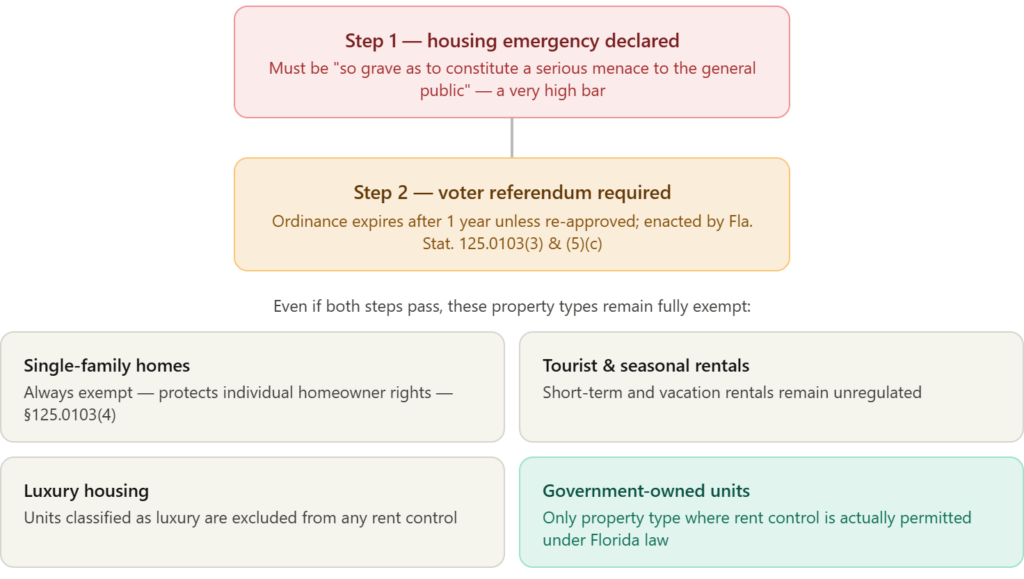
Florida Statute 125.0103(2) explains that local elected officials can only establish rent control measures by declaring a “housing emergency which is so grave as to constitute a serious menace to the general public.” This sets a very high bar, which is why Florida rent control laws are rarely applied in practice.
Even if such an emergency is declared, rent control still faces several strict limitations:
- They automatically expire after one year unless re-approved by voters (Florida Statute 125.0103(3))
- They cannot apply to rental properties such as single-family homes, tourist or seasonal rentals, or buildings classified as luxury housing (Florida Statute 125.0103(4))
- They require voter approval through a referendum to take effect (Florida Statute 125.0103(5)(c))
Florida Statute 125.0103 makes it very difficult for local governments to enforce rent control. There must be a declared emergency, rules must be approved again by voters, and many property types remain exempt.
Because of this, how much a landlord can raise rent in Florida is set by market conditions, not by a fixed legal percentage.
How often can a landlord raise rent in Florida?
Landlords cannot raise rent during an active lease term unless the lease agreement clearly allows it.
In most cases, rent increases happen only after the lease ends or when the lease is renewed, so how often a landlord can raise rent in Florida depends on the lease terms.
For fixed-term leases (like annual or 6-month leases):
- Rent stays the same until the lease expires
- The landlord can propose a new rent at renewal
For periodic leases (like month to month or week to week):
- Landlords can increase rent more often
- They must give proper notice of the rent increase before the next rental period
Unless the lease says otherwise, tenants must receive notice of a rent increase before it takes effect. This gives tenants time to review the new rent or move out if needed.
In simple terms, there is no strict rule on how often rent can increase, but increases must follow the lease terms and proper notice requirements.
Rent increase notice in Florida by the government
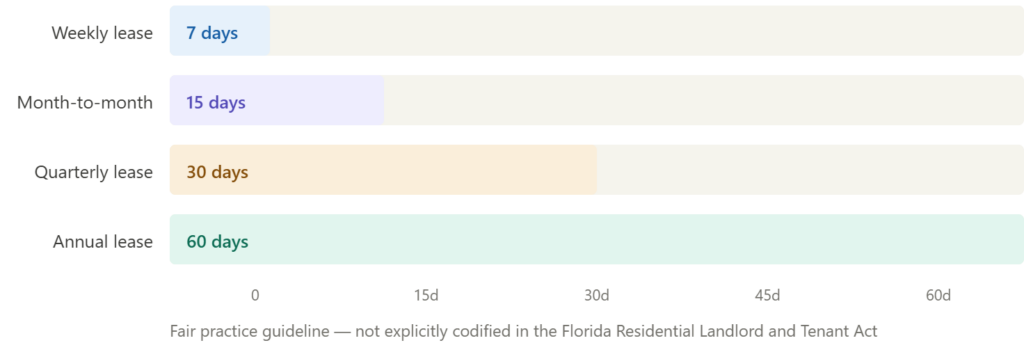
The Florida Residential Landlord and Tenant Act does not contain specific provisions as to how much time landlords need to inform tenants regarding rent increases. It only outlines how much time is required for one party to inform the other about the termination of both fixed and variable leases (Sections 83.57 and 83.575)
As a matter of fair practice, however, landlords and property managers observe this timeframe:
- Weekly lease: 7-day notice prior to lease expiration
- Month-to-month lease: 15-day notice prior to lease expiration
- Quarterly lease: 30-day notice prior to lease expiration
- Annual lease: 60-day notice prior to lease expiration
Single family home rent increase Florida
Single family homes in Florida are exempt from any form of rent control, even during a housing emergency. The exemption aims to protect individual homeowners’ rights while allowing rent control measures to target larger rental properties like multi-family dwellings that have a more substantial impact on housing affordability.
Does Florida have rent control?
No, Florida does not have rent control. On the contrary, Florida has a statewide ban on rent control, enacted in 1977, prohibiting cities and counties from implementing any form of rent regulation on privately owned residential housing units.
This law effectively prevents local governments from placing limits on rent increases or establishing rent control measures. The only exception to the ban applies to housing units owned or operated by governmental entities.
Can a landlord raise rent more than 10% in Florida?
Yes, landlords in Florida can raise rent by over 10% as long as the reasons for the rent increase are done in good faith. Such reasons include:
- Market Conditions: High rental demand allows landlords to raise rents more easily, while oversupply leads to hesitancy in implementing hikes to remain competitive.
- Inflation: Landlords may adjust rents to offset increased operational costs like property taxes, insurance, and maintenance.
- Property Upgrades and Maintenance: Rent hikes can help recoup expenses for renovations, upgrades, or routine maintenance required to preserve property quality and value.
There are instances, however, when raising rent in Florida can be illegal. Under Section 83.64 of the Florida Residential Landlord and Tenant Act, property owners are prohibited from increasing rent for discriminatory or retaliatory reasons:
- Discrimination. Landlords must not treat tenants differently based on protected characteristics such as disability, familial status, gender, national origin, race, religion, military discharge status, skin color, ancestry, or sexual orientation. Landlords must treat all renters equally regarding rent increases, regardless of these factors.
- Retaliation. Landlords cannot retaliate against tenants by raising rent if the renter has reported code violations or joined a tenant’s rights organization. Such retaliatory actions, including rent increases, harassment, or eviction attempts, are unlawful.
Tenants have the right to withhold rent and report landlords if they suspect retaliatory conduct. Florida’s laws aim to protect renters from unfair treatment and ensure landlords operate within legal and ethical boundaries when adjusting rental rates.
What are the new rental laws in Florida?
Florida’s statewide ban on rent control makes other laws regulating rent increases a rarity. Unlike many other states and cities, Florida landlords can raise rents without statutory limitations, as long as proper notice is given.
However, local governments may issue ordinances that regulate how rent increases are carried out. Two such examples are Miami-Dade County and West Palm Beach.
Commissioner Higgins’ Housing Notice Bill
On March 25th, 2022, Miami-Dade County enacted an ordinance mandating landlords to give at least 60 days written notice before raising rent over 5% and extending the eviction notice period from 30 to 60 days.
While Florida state law allows unlimited rent hikes with reasonable notice, this ordinance adds a layer of protection for Miami-Dade tenants. The measure aims to help renters better plan for substantial rent adjustments in a state with no statewide rent control policies.
West Palm Beach Ordinance No. 5007-22
The City of West Palm Beach also adopted Ordinance No. 5007-22 in June to provide additional protections for renters. This ordinance requires landlords to give tenants at least 60 days written notice before terminating a residential lease or increasing rent by more than 5%.
Previously, tenants may have had as little as 30 days or less notice, depending on their tenancy situation. The extended 60-day notice period allows renters more time to decide whether to accept a significant rent hike or relocate.
How to manage your rental property and rent collection
With Florida having no rent control law, landlords and property managers may occasionally find themselves at a loss on how much rent should be raised on their property. Operating expenses must be assessed against prevailing rent on similar properties for them to remain competitive.
Fortunately, property management software like RentPost takes the hassle out of managing rental properties, collecting rent, and even deciding on how much to raise rent once a lease expires.
With a few clicks on the RentPost dashboard, property managers and landlords can generate income and expense reports that will help them decide if they need to raise rent or not.

Rent collection is also a seamless process when managing your properties using the RentPost software:
- Landlords can set up automatic payment reminders through the RentPost platform. Late fees are automatically calculated and applied based on predetermined schedules. Tenants receive rent payment reminders via email or text message.

- Tenants can pay rent online through RentPost’s secure tenant portal using credit/debit card or bank transfer. Receipts for rent payments are generated and sent to tenants electronically.
- Rent payments are automatically recorded and tracked in the RentPost platform, after which they may be deposited into the landlord’s designated bank account.

- Landlords can view rent payment status and outstanding balances in real-time.

- Detailed reports on rent collection, arrears, and payment history can be generated.

Experience unmatched efficiency running your rentals with RentPost property management software. Automate reminders, enable online payments and stay on top of the entire rent process in real time.
Try RentPost risk-free for 30 days and experience game-changing convenience at your fingertips!
Author