Log in
 Free Trial
 karina
  79 views
  0
0
Opening your lease renewal notice and finding your rent has increased by $300 can be a real shock. It is natural to wonder whether your landlord can legally make such a large increase or if there are limits that protect tenants.
The answer is not the same for everyone. In many parts of the United States, landlords can raise the rent by $300 or even more, provided they follow state and local laws and give the required notice. However, if your home is covered by rent control or rent stabilization rules, the increase may be restricted or even prohibited.
So, how do you know if the increase is legal? It depends on several factors, including where you live, the type of rental property you have, and the laws that apply in your city or state.
In this guide, you will learn when a landlord can legally raise your rent by $300, how rent increase laws work, the notice requirements landlords must follow, and what steps you can take if you believe the increase is unfair or unlawful.
Key Takeaways
- In most U.S. states, there is no legal cap on how much a landlord can raise rent, as long as proper notice is given.
- A $300 increase is almost always legal on a market-rate lease once your lease term ends.
- In rent-controlled or rent-stabilized units, a $300 increase is often illegal, since these areas cap increases by percentage, not by dollar amount.
- Landlords cannot raise rent mid-lease unless your lease specifically allows it.
- A rent increase can never be used to discriminate or retaliate against a tenant, regardless of your state’s rent control laws.
Market-Rate vs. Rent-Controlled: The Question That Decides Everything
Before anything else, figure out which category your apartment falls into. Every other answer in this guide depends on it.
- Market-rate apartments: No legal cap on the increase amount. A landlord can raise your rent by $300, $500, or more, once your lease term ends, provided they give you proper notice.
- Rent-controlled or rent-stabilized apartments: Increases are capped by percentage, not dollar amount, set by a local or state rent board. A $300 increase would need your rent to already be quite high for that dollar amount to fall within the legal percentage.
If you’re not sure which applies to you, check your lease for rent stabilization language, or contact your state or city’s housing authority to confirm your unit’s status.
Is a $300 Rent Increase Legal?
A $300 rent increase is not automatically legal or illegal. What matters is how large the increase is compared to your current rent and whether your state or city limits annual rent increases. The easiest way to determine if the increase is reasonable is to calculate its percentage and compare it with any applicable local regulations.
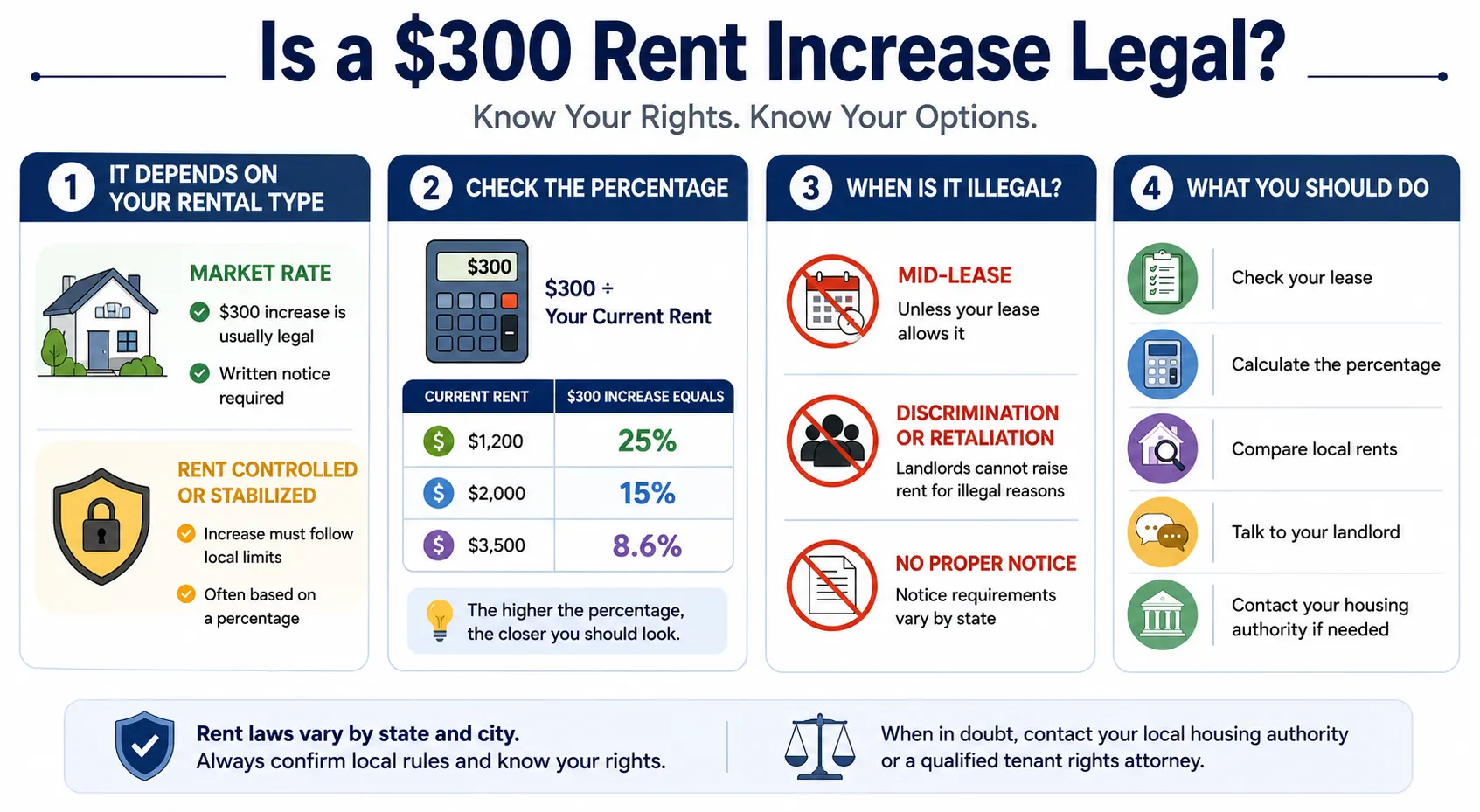
Step 1: Calculate the Percentage Increase
Divide the amount of the rent increase by your current monthly rent.
- $300 increase on $1,200 rent = 25% increase
- $300 increase on $2,000 rent = 15% increase
- $300 increase on $3,500 rent = 8.6% increase
As you can see, the same $300 increase can represent a very different percentage depending on your current rent.
Step 2: Compare the Percentage With Local Rent Laws
If your apartment is covered by rent control or rent stabilization, compare your percentage increase with the maximum annual increase allowed under local law.
If you live in a market rate rental with no rent cap, the percentage is still useful. For example, an 8% increase may be easier to justify based on market conditions, while a 25% increase is much more significant and may be worth discussing or negotiating with your landlord.
Step 3: Check Whether a $300 Increase Is Even Possible Under Rent Control
In rent controlled areas, annual increases are usually capped by a percentage rather than a fixed dollar amount. This means your current rent must already be relatively high for a $300 increase to fall within the legal limit.
For example, if your city allows a 5% annual increase, your monthly rent would need to be $6,000 for a 5% increase to equal $300. For most tenants living in rent controlled or rent stabilized units, a $300 increase would exceed the permitted annual limit.
State-by-State: Where Rent Increases Are Capped
Most U.S. states have no statewide rent control. According to the National Apartment Association, 33 states currently prevent local governments from adopting their own rent regulations. In the states below, however, some form of rent control or rent stabilization applies:
| State | What the Law Says |
| California | Under the Tenant Protection Act, covered landlords cannot raise rent more than 5% plus local cost of living, or 10% total, whichever is lower, in a 12-month period. See our full California rent increase guide for exemptions and local ordinances. |
| New York | Rent-stabilized and rent-controlled units follow strict formulas set by regional Rent Guidelines Boards. Market-rate NY units have no cap. See our New York City rent increase guide for exact current percentages. |
| New Jersey | No statewide cap, but over 100 municipalities set their own limits, typically 3% to 6%. See our New Jersey rent increase guide for city-by-city rules. |
| Florida | No statewide rent control, and Florida law prohibits most local governments from enacting it. See our Florida rent increase guide for notice requirements. |
| Texas | No statewide or local rent control. See our Texas rent increase guide for notice rules that still apply. |
| Massachusetts | No statewide rent control (banned since 1994), though notice and eviction protections still apply. See our Massachusetts rent increase guide for details. |
| Maryland | No statewide cap, but cities like Takoma Park have local rent stabilization laws. See our Maryland rent increase guide for local exceptions. |
| Oregon | Rent increases are capped at the lesser of 7% plus CPI or 10% annually, with some exemptions for newer buildings. |
| Washington, D.C. | Rent stabilization limits most increases to CPI plus 2%, capped at 4.9% (2.9% for qualifying seniors or disabled tenants). |
| Minnesota | No statewide cap, but St. Paul has a 3% annual limit with some exceptions. Minneapolis has enabling legislation but no active ordinance. |
If your state isn’t listed here, it likely has no statewide rent control, meaning the market-rate rules below apply to you.
Notice Requirements for a Rent Increase
Even where there’s no cap on the amount, your landlord still has to follow notice rules. These are the most common standards, though your state or city may set stricter requirements:
- Month-to-month tenancy: Typically 30 days’ written notice.
- Increases of 5% or more: Many states, including New York, require longer notice, 30, 60, or 90 days, based on how long you’ve lived there.
- Fixed-term lease: Your landlord generally cannot raise rent until your current lease term ends, unless your lease includes a clause allowing a mid-lease increase.
As per the New York State Attorney General’s guidance, New York tenants are entitled to 30, 60, or 90 days’ advance written notice for any increase of 5% or more, scaled to how long they’ve lived in the unit. If proper notice isn’t given, tenants have the right to stay at their current rent until the required notice period has passed.
When a Rent Increase Becomes Illegal
Even in areas with no rent cap, certain increases are against the law:
- Discrimination: A rent increase cannot target you based on race, religion, national origin, sex, familial status, or disability, protections guaranteed under the federal Fair Housing Act.
- Retaliation: Your landlord cannot raise your rent as punishment for reporting unsafe conditions, requesting repairs, or exercising any legal right.
- Mid-lease increases: If you’re under a fixed-term lease, your landlord generally cannot raise your rent before the lease ends, unless your lease specifically allows it.
- Missing or improper notice: If your landlord doesn’t follow your state’s required notice period, the increase may not be enforceable yet.
What to Do If You Receive a $300 Rent Increase Notice
A $300 rent increase does not necessarily mean your landlord has violated the law. Before accepting or challenging the increase, take these steps to understand your rights and decide on the best course of action.
- Confirm your apartment’s status: Check your lease or contact your local housing authority to determine whether your unit is market rate, rent controlled, or rent stabilized.
- Calculate the percentage increase: Compare the $300 increase with your current monthly rent to understand how significant the increase is.
- Review the notice: Make sure your landlord provided written notice and followed your state’s required notice period.
- Compare local rental prices: Research similar rental properties in your area to see whether the new rent is in line with the current market.
- Negotiate with your landlord: If the increase seems too high, discuss your concerns. A good rental history or agreeing to a longer lease may help you negotiate a lower increase.
- Seek legal help if necessary: If you believe the increase violates rent control laws or notice requirements, contact your local housing authority or a qualified tenant rights attorney.
Frequently Asked Questions
Can my landlord raise my rent $300 dollars?
In a market-rate apartment with no rent control, yes, as long as proper written notice is given and your lease term has ended. In a rent-controlled or rent-stabilized apartment, a $300 increase usually exceeds the legal percentage cap unless your rent is already quite high.
How much notice does my landlord need to give?
It depends on your state and how long you’ve lived in the unit. A common standard is 30 days for month-to-month tenancies, with longer notice, sometimes 60 or 90 days, required for larger increases or longer tenancies.
Can my landlord raise my rent in the middle of my lease?
Generally, no. A fixed-term lease locks in your rent until the lease ends, unless your lease includes a clause specifically allowing a mid-term increase.
Which states have rent control?
California, New York, New Jersey (locally), Oregon, Washington D.C., Maine (locally), Maryland (locally), and Minnesota (locally) all have some form of rent control or rent stabilization. Most other states have no statewide rent control, and many prohibit their cities from creating local rent regulations.
What can I do if my rent increase seems too high?
Confirm your apartment’s rent-control status, check that proper notice was given, and compare the increase to local market rates. If it appears to violate the law, contact your state or city’s housing authority to file a complaint.
Legal Disclaimer
This article is provided for general informational and educational purposes only and should not be considered legal advice. Rent increase laws vary significantly by state, city, lease type, and are subject to change. For guidance specific to your situation, consult your local housing authority or a qualified tenant rights attorney to verify the current laws and requirements in your area.
Author