Log in
 Free Trial
 jacob-thomason
  657 views
  1
1
How much a landlord can raise rent in Seattle changed significantly with Washington’s House Bill 1217, and this article is updated for 2026 to reflect the current rules every landlord and tenant needs to know. Seattle now caps annual rent increases at 7% plus inflation or 10%, whichever is lower, with a mandatory 180-day written notice requirement before any increase takes effect.
According to the U.S. Department of Housing and Urban Development, Seattle ranks among the highest-cost rental markets in the Pacific Northwest, with median rents consistently exceeding national averages. This guide covers the cap, exemptions, notice rules, and tenant protections in plain language.
TL;DR: Quick Summary
- Seattle landlords cannot raise rent by more than 7% plus CPI or 10% per year, whichever is lower, under Washington House Bill 1217.
- Landlords must give at least 180 days written notice before any rent increase takes effect.
- Rent cannot be raised during the first 12 months of tenancy or during a fixed-term lease unless the lease specifically allows it.
- Increases of 10% or more within a 12-month period require landlords to attach an Economic Displacement Relocation Assistance (EDRA) notice.
- Exemptions include buildings 12 years old or newer, public and nonprofit housing, and certain owner-occupied properties.
- Landlords who violate Seattle’s rent cap laws face civil penalties of up to $7,500 per violation plus mandatory damages and attorney fees.
How Much Can a Landlord Raise Rent in Seattle?
Landlords must follow state and city rules in order to raise rent in Seattle. Under Washington’s House Bill 1217, they can’t increase rent during the first 12 months of tenancy. After that, the rent can only be raised by up to 7% plus inflation, or 10% total per year, whichever is lower.
For a broader national picture of how rent increase rules vary by state, our guide on how much and how often rent can be raised covers the key rules across major U.S. markets.
Seattle adds its own rules on top. For example, property owners must give renters at least 180 days’ written notice before any increase, and increases can only happen at the start of a rent period. If rent goes up by 10% or more in a year, the landlord must include a notice offering Economic Displacement Relocation Assistance (EDRA), which means eligible tenants may be eligible for help like 3 months’ rent to move out.
However, some properties are exempt from these rent increase limits:
- Newly constructed buildings (12 years old or less)
- Public housing or non-profit housing where rents are regulated
- Certain owner-occupied homes (not owned by a corporation or REIT), including when the tenant shares a bathroom or kitchen with the owner, single-family homes with up to two rented units or rooms (including ADUs/DADUs), or duplexes/triplexes/fourplexes where the owner lives in one unit
Is There a Limit on Rent Increase in Seattle?
Yes, there’s now a clear Seattle rent increase limit in place. Landlords are prohibited from raising rent by more than 7% plus inflation (CPI) or 10% per year, whichever is lower. This rule is designed to give renters more stability and predictability in housing costs.
For most renters, it’s capped at 10% annually, but exemptions apply to new buildings (under 12 years old), public/non-profit housing, and certain owner-occupied homes.
How Often Can a Landlord Raise Rent in Seattle?
Landlords can raise rent only once per year in Seattle, excluding the first 12 months of tenancy.
Rent Increase Notice Seattle by Government
A landlord must provide a minimum of 180 days’ advance written notice before increasing the rent. The notice may be delivered in-person, by posting on the property’s main gate, or by mailing by first class mail.
According to the Seattle city government notification for landlords:
“Housing cost increase notices issued on or after July 1, 2022, may trigger EDRA (Economic Displacement Relocation Assistance) if the increase equals or exceeds 10% within the same 12 month period. When an increase reaches 10% or more you must attach an EDRA notice to the notice of increase for your tenants.”
Can a Landlord Raise Rent More Than 10% in Seattle?
In Seattle, a landlord can’t raise rent by more than 10%. The House Bill 1217 restricts rent hikes to 7% plus the Consumer Price Index (CPI), or a maximum of 10%, whichever is less.
What Are the New Rental Laws in Seattle 2026?
Seattle’s rental laws are designed in a way to make housing fairer and more balanced for both tenants and landlords. These rules cover evictions, deposits, repairs, and even financial help when tenants are forced to move. Let’s break them down.
Eviction Law
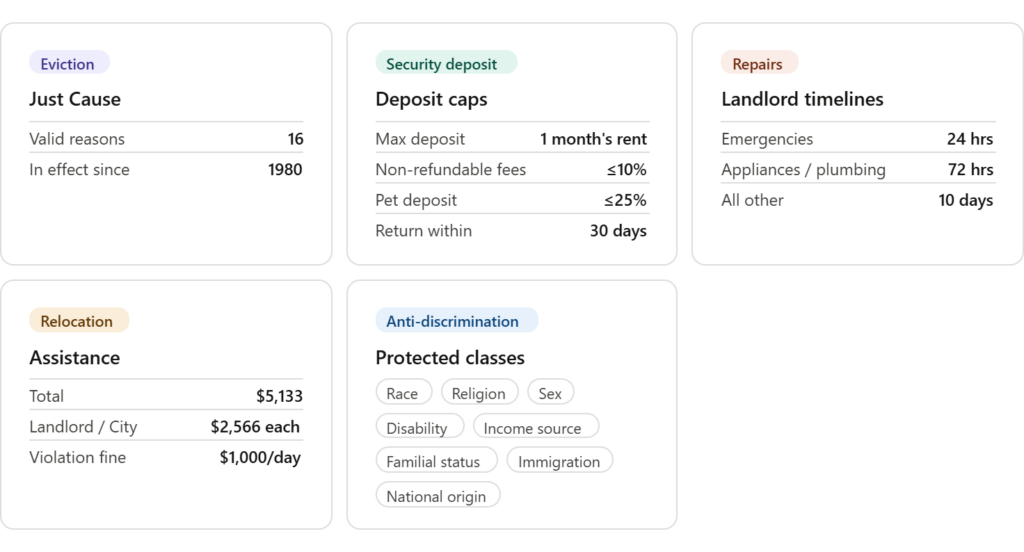
Seattle passed the Just Cause Eviction Ordinance in 1980 to protect tenants from unlawful evictions. The landlord must have at least one of the 16 approved reasons listed in the Just Cause Eviction Ordinance to evict a tenant, as well as comply with the Rental Registration & Inspection Ordinance.
Security Deposit Law
How much is a security deposit in Seattle?
The city in Washington caps refundable security deposits at one month’s rent, and non-refundable fees for cleaning and screening can’t be more than 10% of that rent. For example, if one month’s rent is $1,000, non-refundable fees (cleaning and screening only) can’t exceed $100, restricting the security deposit amount to $900.
A 25% of one month’s rent can be charged as a pet deposit, if applicable, in addition to the security deposit and fees. Tenants also have the right to pay deposits in installments if they want to.
They must return it, with an itemized list of deductions if any, within 30 days after the tenant moves out, according to RCW 59.18.280.
For practical landlord guidance on managing deposits correctly, our guide on security deposit tips for landlords covers documentation, deductions, and return timelines that apply across most U.S. states.
Repair and Deduct Law
If the landlord doesn’t take care of repairs after the tenant has sent them a written request, Washington law allows the latter to hire a licensed contractor to fix the issue and then deduct the repair cost from the following month’s rent.
But landlords are also on a timeline once a written request is submitted:
- 24 hours: For emergencies like no water, no electricity, no heat in winter, or any life/safety hazard
- 72 hours: If the fridge, stove, or oven stop working, or for serious plumbing problems with sinks or bathtubs
- 10 days: For all other repair needs
Tenant Relocation Assistance Ordinance
The Seattle City Council introduced the Tenant Relocation Assistance Ordinance on June 25, 1990, which grants relocation assistance of $5,133.00 (the landlord pays half of this amount, i.e., $2,566 and the City of Seattle pays the other half, i.e., $2,566) to low-income households and adequate time to search for new housing and move.
Note: Violating Tenant Relocation Assistance Ordinance is subject to fines and penalties of up to $1,000 per day.
Anti-Discrimination Law
The Fair Housing Act and Seattle’s Fair Chance Housing legislation prohibits discrimination against tenants by landlords and real estate companies because of:
- Race
- Color
- Religion
- Sex
- National origin
- Income source
- Immigration status
- Familial status (presence of children under the age of 18 or pregnancy)
- Disability
- Disability Group Homes
How to Manage Your Rental Property and Rent Collection?
Managing rental properties and collecting rent using the old-school spreadsheets is a thing of the past. Property management software, on the other hand, is so convenient that it makes things much easier and faster for property managers, landlords, and tenants.
A property manager shared on Reddit, “I’m a full time property manager with my own rentals. I tried doing my own properties manually and completely messed it all up. Tracking income and expenses is time consuming without software. Maintenance tracking is also huge. Long term record keeping and document management are other needs to have aspects that software will give you.”
You would also want to read the experience of this Reddit user with PMS, who says, “Property management software saves so much time by automating tasks like rent collection and maintenance requests, plus it helps cut errors with better tracking and reports.”
At the end of the day, managing rentals doesn’t have to be a headache. With the right software, payments are on time, repairs stay tracked, and everyone stays in the loop, giving landlords confidence and tenants a smoother living experience.
How RentPost Helps Manage Your Rental Property and Rent Collection?
RentPost helps manage your rental property and rent collection. One happy user rated RentPost 4.5/5 on G2, and said, “I find RentPost’s template to be easy to use and only include the significant property details that I should mention. A high-quality picture uploading feature as a new highlight pattern, it makes my site distinct from the other competitors.”
If you’re new to RentPost, here’s an overview of what this cloud-based property management tool can do:
- Real-Time Payment Tracking: With RentPost, easily track rent payments and outstanding balances in real-time with the status of each payment just a click away.
- Tenant Screening: Rent out your property to only trustworthy tenants after end-to-end screening that includes thorough background checks, credit checks, eviction history, identity verification, and more.

- Scalability: Add new units and tenants as your rental portfolio grows, and scale your business with minimal effort.

- Automated Payment Reminders: Automated payment reminders mean no more late rent payments. The PMS automatically calculates and applies late fees based on the schedules you define, so you never have to chase payments again.

- Work Order Management: Save time and money by streamlining work orders with RentPost. Accept maintenance requests from tenants, assign them to the respective maintenance personnel or managers, and the tool will take care of the rest.
- Financial Report Generation: Get valuable insights into your apartment’s finances through income and expense reports. Identify the right time to adjust rent prices based on your property’s performance.

Explore rent laws in other regions of the US:
- How much can you raise rent in California?
- How Much Can You Raise Rent in New Jersey?
- How Much Can You Raise Rent In Florida?
- How much can you raise rent in NYC?
- How Much Can You Raise Rent in Oregon?
- How Much Can You Raise Rent in Los Angeles?
- How Much Can You Raise Rent in San Diego?
- How Much Can You Raise Rent in Pennsylvania?
- How Much Can You Raise Rent in Massachusetts?
- How Much Can You Raise Rent in Chicago?
- How Much Can You Raise Rent in Illinois?
- How Much Can You Raise Rent in Maryland?
- How Much Can You Raise Rent in Michigan?
FAQs
1. How much can a landlord raise rent in Seattle in 2026?
A landlord can raise rent in Seattle by a maximum of 7% plus the Consumer Price Index (CPI) or 10% per year, whichever is lower. This cap is set by Washington House Bill 1217 and applies to most residential rental properties, excluding buildings under 12 years old and certain owner-occupied homes.
2. How much notice does a landlord have to give before raising rent in Seattle?
Seattle landlords must give tenants a minimum of 180 days written notice before a rent increase takes effect. Notice can be delivered in person, posted on the property’s main gate, or sent by first-class mail. The increase can only begin at the start of a new rent period.
3. Is there rent control in Seattle?
Yes, Seattle follows Washington’s House Bill 1217, which caps annual rent increases at 7% plus inflation or 10%, whichever is lower. This applies to most residential properties. Exemptions include newly constructed buildings 12 years old or less and certain owner-occupied or nonprofit-operated properties.
4. What is EDRA in Seattle rental law?
EDRA stands for Economic Displacement Relocation Assistance. If a Seattle landlord raises rent by 10% or more within a 12-month period, they must attach an EDRA notice to the increase notice. Eligible low-income tenants may receive relocation assistance equivalent to three months of rent to help cover moving costs.
5. Can a landlord raise rent during a lease in Seattle?
No. A landlord cannot raise rent during a fixed-term lease in Seattle unless the lease agreement specifically allows it. Once the lease term ends, the landlord may adjust rent at renewal, provided they give the required 180 days written notice before the new rate takes effect.
6. What happens if a Seattle landlord raises rent illegally?
If a Seattle landlord raises rent without following the law, they face civil penalties of up to $7,500 per violation, plus attorney fees and mandatory damages to the tenant. In August 2025, eight Washington landlords were each fined $2,000 for violating the state rent cap. Tenants can also break their lease with 20 days notice.
Author